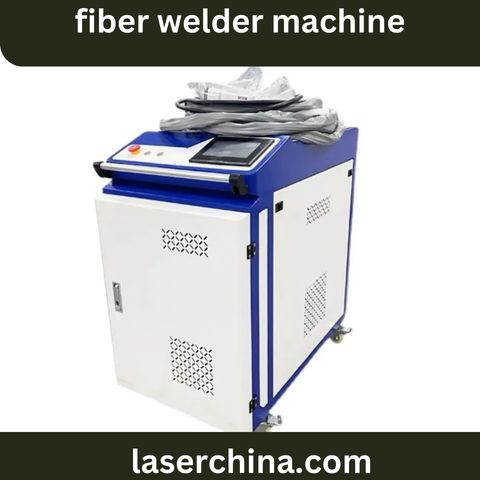

The fiber welder machine has become an essential tool in modern welding and metal fabrication industries. With its precision and efficiency, it is widely utilized across sectors ranging from automotive manufacturing to intricate industrial repairs. The machine operates on a high-intensity light source that produces a concentrated fiber laser beam, ensuring highly accurate welding of metals and alloys. Unlike conventional welding methods, the fiber welder machine focuses energy precisely on the welding point, allowing for smooth fusion and consistent results across various applications.
Industries that rely on metal joining processes have increasingly turned to fiber welding technology for its unparalleled performance. Automotive manufacturers, for instance, use fiber welder machines to assemble car bodies, frames, and critical components with meticulous accuracy. Each weld contributes to the structural integrity and durability of vehicles, making this equipment indispensable for high-quality production. Similarly, aerospace manufacturers employ fiber welding to join critical parts that require precision and high-strength bonding. The laser’s focused energy allows for minimal heat-affected zones, preserving the material properties and maintaining the overall quality of aerospace components.
Another area where the fiber welder machine plays a crucial role is in industrial maintenance and repairs. Factories and heavy industries rely on metal equipment and machinery that undergoes significant wear and tear. Fiber welding enables the restoration and strengthening of worn-out parts without the need for complete replacement. Metal surfaces can be fused seamlessly, extending the life of machinery and reducing downtime in production. The precision of the fiber laser ensures that even the smallest components are welded accurately, which is particularly valuable in industries where tolerances are tight and errors are costly.
In addition to industrial applications, the fiber welder machine is also widely used in the manufacturing of consumer products. Jewelry and fine metalwork require precise joining of metals without altering their aesthetic appeal. Fiber welding offers a controlled process that allows for delicate operations on thin metals and intricate designs. This capability has made the machine a preferred choice for artisans and manufacturers who demand both accuracy and visual perfection.
The technology behind the fiber welder machine is built on advanced fiber optic principles. The fiber laser generates a coherent light beam that is directed to the welding point with minimal energy loss. This method ensures efficient energy transfer and a concentrated heat zone, allowing metals to fuse quickly and uniformly. Moreover, the machine can be adjusted for different power levels and welding speeds, enabling operators to work with various metal types, thicknesses, and project specifications. This adaptability makes the fiber welder a versatile solution across multiple industries.
Automotive repair shops and custom fabrication studios have also benefited from integrating fiber welding into their operations. Structural repairs, custom metal designs, and prototype creation all require precise and reliable joining methods. The fiber welder machine provides a consistent and repeatable process, ensuring each weld meets exact standards. The speed and accuracy of the machine allow for faster production timelines without compromising quality, making it a valuable investment for both small workshops and large-scale manufacturing facilities.
The medical and electronics industries are additional sectors where the fiber welder machine demonstrates its importance. In medical device manufacturing, small metal components often need to be joined with extreme precision to meet strict regulatory standards. Fiber welding offers a clean, controlled, and repeatable process, ensuring the reliability of critical devices. Similarly, electronic components often include thin metal sheets and wiring that must be joined without causing damage or misalignment. Fiber welding enables such delicate work with unmatched precision, supporting advancements in technology and device manufacturing.
Environmental and safety considerations are also addressed through fiber welding technology. Unlike traditional welding processes that produce extensive fumes, sparks, and heat, the fiber welder machine is a cleaner solution. The focused energy reduces unnecessary material damage and minimizes workplace hazards. Operators benefit from a more controlled environment where risks are lower, and efficiency is higher. This aspect makes the machine attractive for facilities that prioritize safety standards and environmental compliance.
The growing demand for high-precision manufacturing and repair has led to continuous improvements in fiber welder machine designs. Modern machines incorporate advanced control systems, intuitive interfaces, and automated features that enhance accuracy and productivity. These developments have expanded the range of applications, allowing the machines to be used for everything from large-scale industrial projects to delicate artisanal work. Businesses that integrate fiber welding technology gain a competitive edge by delivering superior results with reduced production time and consistent quality.
Moreover, the fiber welder machine plays a pivotal role in research and development. Prototyping and testing new metal designs often require exact and repeatable welding processes. Researchers rely on fiber welding for rapid iteration and reliable results, enabling them to refine designs efficiently. The machine’s precision also allows for experimentation with new alloys and materials, pushing the boundaries of manufacturing innovation.
Training and operational expertise are essential for maximizing the potential of a fiber welder machine. Operators learn to adjust power settings, focus the laser beam, and control welding speed to achieve the desired outcomes. Proper training ensures that the machine operates at peak efficiency and produces consistently high-quality welds. With skilled operators, businesses can fully leverage the machine’s capabilities, improving production quality, reducing material waste, and optimizing project timelines.
As industries continue to evolve and demand higher standards of manufacturing and repair, the fiber welder machine remains a central tool. Its versatility, precision, and efficiency make it indispensable across a wide range of applications, from heavy industry and automotive production to medical devices and fine metalwork. By integrating fiber welding technology, businesses can achieve consistent results, maintain high-quality standards, and streamline their production processes.
In conclusion, the fiber welder machine represents a modern approach to metal joining and fabrication. Its use in industrial, commercial, and artisanal applications highlights its adaptability and reliability. The technology enables precise, controlled, and efficient welding, ensuring superior outcomes across different metal types and project requirements. Businesses and professionals that rely on high-quality metal welding continue to adopt fiber welding solutions for their accuracy, productivity, and long-term value.