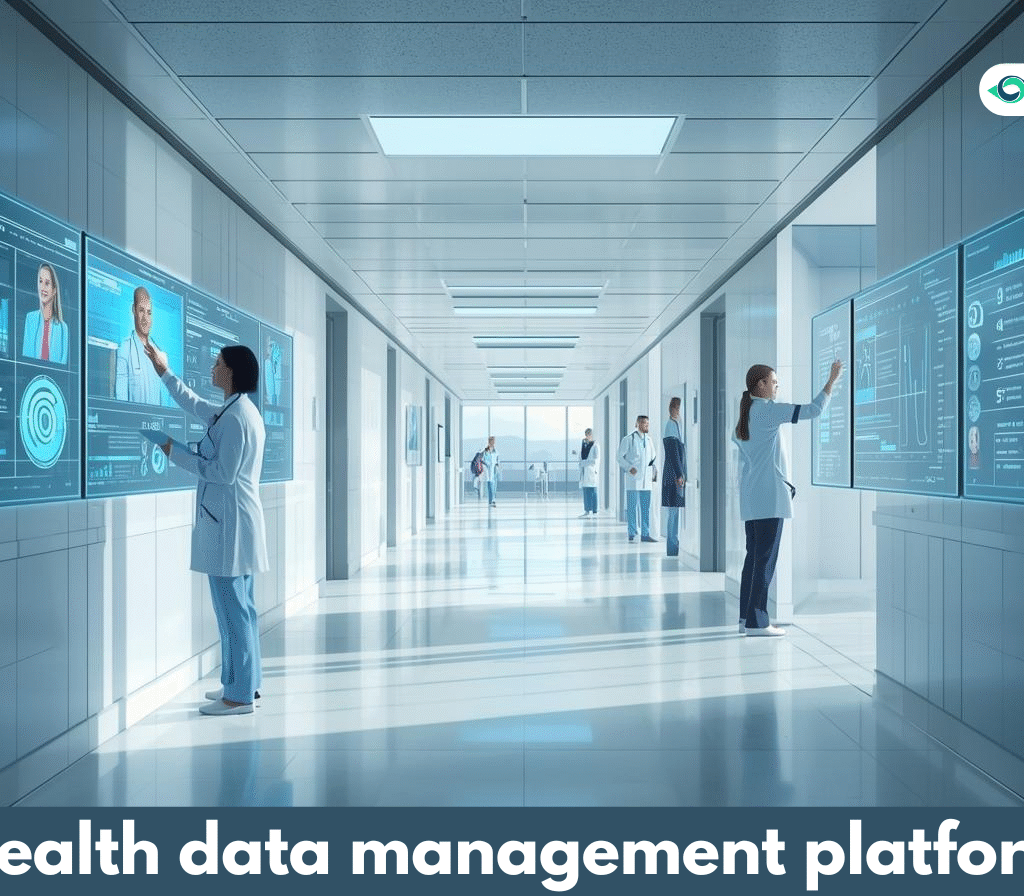

The hospital employees spend an average of almost a quarter of their day locating patient information in isolated systems. To access the history of a single patient, nurses switch between 5 screens. With physicians, more time is spent on writing care rather than giving care. This bureaucratic weight not only frustrates the medical practitioners, but it also slows down treatment and increases medical errors.
Health data management platforms help to overcome these bottlenecks by establishing a single source of patient data. These platforms draw data on electronic health records, laboratory systems, imaging databases, claims data, and wearable devices into a single longitudinal patient record. Medical personnel can find all they require at the same location, hence making decisions quicker and dedicating more time to direct patient care. The result? Hospitals save time on documentation, decrease duplication of tests, and enhance coordination of care across departments.
What Are Health Data Management Platforms?
HDMPs are computer-based systems that are used to collect, organize, and analyze health data from various sources. They develop a single patient perspective through the integration of clinical documentation, billing data, social determinants of health, and real-time device data. These platforms apply artificial intelligence to detect patterns, make predictions of health risks, and produce actionable insights at the point of care.
Key components include:
- Data acquisition engines connecting to multiple sources
- Natural language processing for unstructured clinical notes
- Enterprise master patient index for accurate patient matching
- Real-time analytics dashboards
- Automated workflow triggers based on clinical rules
FHIR-compliant systems ensure interoperability across different healthcare IT systems, making data exchange seamless between hospitals, clinics, and external providers.
How Do Hospitals Save Time With These Platforms?
Health data management platforms help modern healthcare organizations to optimize operations and achieve administrative load reduction in all departments. These systems operate like background programs that go through the incoming data streams, constantly updating patient records automatically, and do not need to be worked on by the staff.
The systems make repetitive freedom and deliver information at the point of need to the clinicians. Rather than patients having to search through several different systems, healthcare teams can access all the relevant clinical data on the comprehensive patient history of a patient in a single interface.
Eliminating Manual Data Entry
Manual data entry consumes a major part of nursing time during typical shifts. HDMPs automatically capture data from connected devices, lab interfaces, and external health systems without human involvement.
Time savings include:
- No duplicate entry across multiple systems
- Automatic population of intake forms from prior visits
- Direct data feeds from medical devices to patient records
- Pre-filled medication reconciliation based on pharmacy data
- Automated insurance verification and eligibility checks
Creating Unified Patient Views
Physicians previously spent 15-20 minutes per patient gathering information from separate systems. The fact that everything has been reduced to a single interface in a unified longitudinal patient record.
The system consolidates all care locations, medical history, current medications and allergies, recent lab findings and imaging reports, social determinants of health, patient-reported outcomes from mobile applications, and insurance data. The clinicians view the entire picture within less than 30 seconds. They can make decisions based on good decisions without having to wait for records that are provided by external providers or search through archived files.
Accelerating Clinical Decision-Making
Real-time analytics convert raw data into usable clinical information. The platforms conduct thousands of evidence-based algorithms at the same time, which test drug interactions, gaps in care, and early warning indicators.
Instant alerts help providers:
- Identify patients at risk for sepsis or readmission
- Flag contraindicated medications before ordering
- Detect missed preventive screenings
- Monitor chronic disease progression
- Track compliance with treatment protocols
The physicians in the emergency department are provided with risk stratification scores seconds after patients arrive at the facility. They prioritize cases in a more appropriate way and start time-sensitive interventions in a quicker manner.
Reducing Duplicate Testing
Hospitals waste resources repeating tests that other facilities already performed. Digital health platform technology integrates external records and flags recently completed procedures.
Before ordering imaging or lab work, clinicians see test results from other hospitals in the network, recent procedures at external facilities, historical trends showing whether repeat testing adds value, and evidence-based guidelines for testing intervals. This visibility prevents unnecessary testing while ensuring patients get appropriate care.
Technical Capabilities That Drive Efficiency
The underlying architecture determines how effectively these platforms save time. High-performing systems and simple repositories of data are distinguished by advanced technical features. Advanced health information management systems utilize advanced technology to process transactions automatically and provide insights at the point of care.
Data Fabric Architecture
A robust data fabric automates interoperable data pipelines without manual configuration. Pre-built metadata and semantic sets enable instant connections to new data sources.
The data quality and validation can be controlled automatically by the fabric layer, which further ensures that the data has a lineage that can be audited, governance rules are enforced uniformly, it is capable of scaling to support millions of transactions a day, and can be updated in real-time as more information is added. This architecture means IT teams spend less time on integration projects. Systems connect to many sources using advanced natural language processing and enterprise master patient indexing.
AI and Machine Learning Integration
Artificial intelligence infused into every platform layer accelerates workflows and reduces cognitive burden. Machine learning models analyze patterns across millions of patient records to generate predictions.
AI capabilities include:
- Natural language processing for unstructured clinical notes
- Predictive analytics for readmission risk
- Prescriptive recommendations for treatment pathways
- Pattern recognition for early disease detection
- Automated coding and billing optimization
These models train on extensive healthcare data, producing stable, accurate results without hallucination. Clinical teams trust the insights and act on recommendations confidently.
FHIR-Enabled Interoperability
FHIR compliance ensures seamless data exchange with external systems, payers, and health information exchanges. Standards-based APIs connect platforms to thousands of healthcare applications.
Interoperability will allow sharing records instantly across care environments, integrating with patient engagement applications, connecting with remote monitoring devices, submitting data to quality registries, and being a part of value-based care programs. Hospitals have unnecessarily expensive custom integrations and connect with new partners within days instead of months.
Measured Impact on Hospital Operations
Deploying these platforms creates measurable operational improvements across clinical and administrative functions. Healthcare organizations track specific metrics to quantify time savings and demonstrate return on investment. Real-world implementations consistently show substantial efficiency gains across all departments.
Emergency Department Results
ED physicians access complete patient histories before walking into exam rooms. The platform pulls records from previous visits, current medications from retail pharmacies, and recent specialist notes.
Improvements:
- Reduction in average door-to-provider time
- Fewer calls to outside providers for records
- Faster disposition decisions with complete information
- Better identification of frequent utilizers
- Reduced time spent documenting chief complaints
Inpatient Care Delivery
Hospital floors manage complex patients with multiple conditions and numerous medications. The HDMPs provide the information that is relevant depending on the characteristics of the needs of each patient and the ongoing issues.
Automated rounding lists with more recent vitals, medication reconciliation in 5 minutes rather than 20, instant notifications upon critical results returning, embedded care gap alerts within daily workflows, and simplified inter-shift handoff reports are clinically valuable to care teams. After the ease of documentation burden, 45 extra minutes of direct patient care time per shift are reported by nurses.
Quality Reporting Efficiency
Manual chart abstraction for quality measures consumes significant nurse and analyst time. Automated measure capture extracts data directly from clinical workflows without separate documentation.
For instance, check out this estimation:
| Metric | Baseline | Post-Implementation | Time Saved |
| Chart Review Time | 18 minutes | 5 minutes | 13 minutes per patient |
| Duplicate Test Orders | 15% of studies | 4% of studies | 11% reduction |
| Documentation per Patient | 25 minutes | 15 minutes | 10 minutes per encounter |
| Discharge Processing | 4.5 hours | 2.8 hours | 1.7 hours per discharge |
Quality departments reduce reporting cycles from weeks to hours while improving measurement performance.
Implementation Success Factors
Planning and change management are necessary to maximize adoption and faster time-to-value to achieve successful deployment. Those hospitals that handle typical barriers early experience greater employee satisfaction and quantifiable efficiency improvements in the initial quarter of the implementation.
Data Integration Strategy
Legacy systems contain valuable historical data that must be transferred to new platforms. Automated migration tools and experienced implementation teams ensure data accuracy.
Best practices include:
- Phased rollout starting with high-value data sources
- Parallel operation during the initial months
- Comprehensive data validation and reconciliation
- Training for staff on new workflows
- Dedicated support during the go-live period
Organizations typically achieve full integration within 3-6 months, depending on system complexity.
User Adoption Approaches
The saving of time by technology only happens when it is used by the staff. The adoption is promoted with the use of intuitive interfaces and workflow-built tools that do not require intensive training.
Proper measures are role-based understanding, where only relevant information is shown, physician and nurse access via mobile, quick reference guides to common tasks, peer support via super-user protocol, and periodical feedback to discuss concerns. Hospitals with strong change management see 90%+ user adoption within the first quarter.
Final Insights
Health data management systems revolutionize the work of hospitals by eradicating manual operations and providing immediate access to all patient information. They simplify documentation and lessen redundant testing, and improve the coordination of care-assisting teams to make data-driven decisions faster. Hospitals with such systems also record 30-40 percent less time in administration and quality of care.
Persivia’s AI-powered platform combines thousands of sources of data, is interoperable in FHIR, has a strong data architecture, and is powered by analytics in real-time. It automates the workload, improves data accuracy, and allows health care professionals to devote more time to the patients and less to paperwork. Learn more.
FAQs
Q1: Do health data management platforms integrate with existing hospital systems?
Yes, modern HDMPs use FHIR-compliant APIs and support all healthcare standards, formats, and vocabularies. They connect seamlessly with electronic health records, lab systems, imaging databases, and billing platforms without requiring complete system replacement.
Q2: How long does it take to implement a health data management platform?
No, implementation timelines vary by organization size and complexity. Most hospitals achieve initial integration within 3-6 months with phased rollouts. Full optimization typically occurs within the first year as staff adopt new workflows.
Q3: Can smaller hospitals afford health data management platforms?
Yes, HDMPs deliver ROI through reduced administrative costs, decreased duplicate testing, and improved operational efficiency. Time savings translate directly to reduced overtime expenses and increased patient capacity.