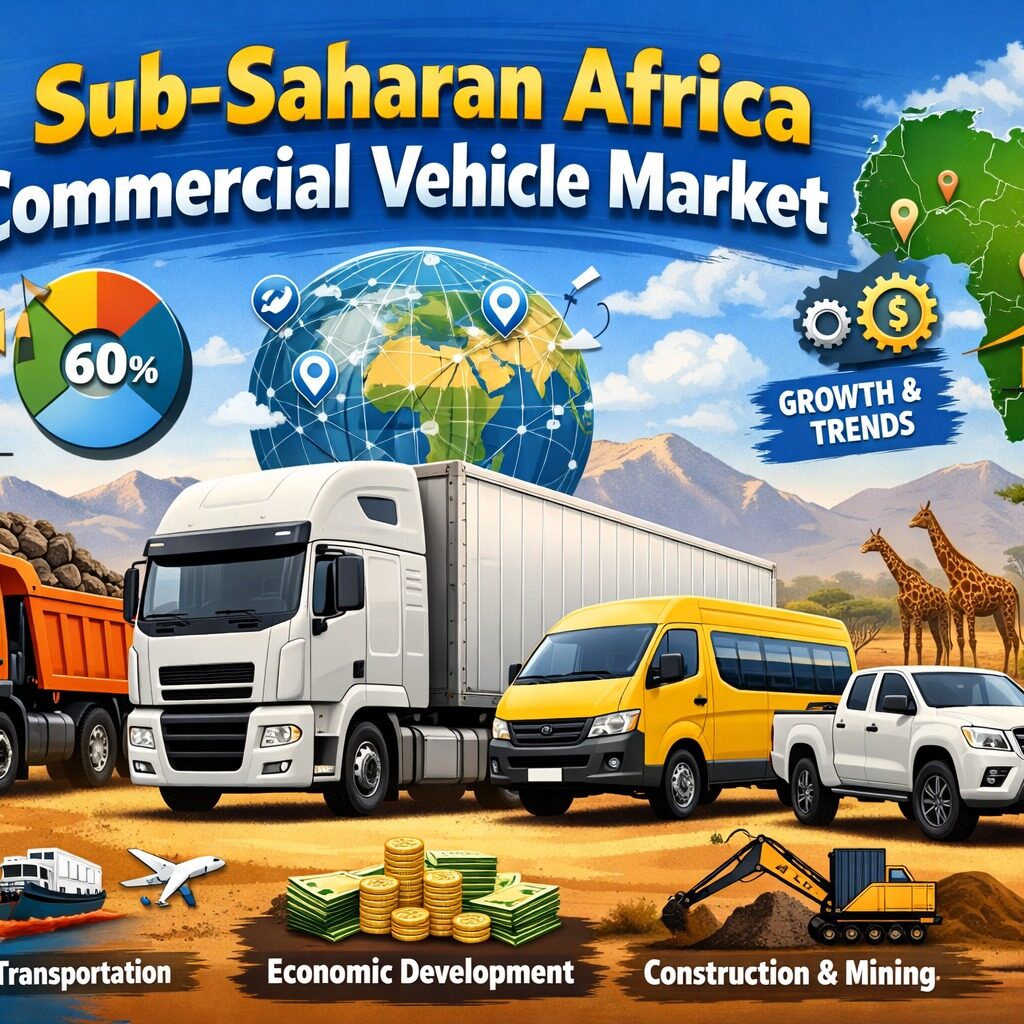

In Sub-Saharan Africa, commercial vehicles are not merely a factor of transportation, but it is an economic facilitator. Trucks, buses, light commercial vehicles constitute the backbone of regional trade and movement since they are used to transport agricultural goods to the market and to transport landlocked nations to the ports. The Sub-Saharan Africa Commercial Vehicle Market is increasingly becoming strategically critical to the manufacturers, logistics services, policy makers, and investors, as infrastructure is being rapidly invested in and methods of intra-African trade become more deeply entrenched.
The importance of commercial vehicles in Sub-Saharan Africa
In contrast to developed car markets, the commercial car consumption in Sub-Saharan Africa is directly linked to the vital economic process. The construction projects, mining processes, agricultural supply chains and the transportation systems of the people all depend on the reliable commercial fleets. Urban and peri-urban logistics are characterized by light commercial vehicles (LCVs) whereas the long-haul freight across borders is assisted by medium and heavy-duty trucks.
As the population increases, urbanization accelerates, and the African Continental Free Trade Area (AfCFTA) is put into practice, the need to have an efficient and scalable transport solution will keep on increasing in the region.
Major forces influencing the development of the market
The regional commercial vehicle market is experiencing growth because of a number of structural and policy- facilitated aspects:
Infrastructure development
Governments and development banks are still investing in roads, ports, rail connections and industrial corridors. These initiatives boost the demand of the tippers, haulage trucks, concrete mixers and specialized construction vehicles directly.
Farming and material logistics
In Sub-Saharan Africa, agriculture provides a large proportion of people with their jobs. Business vehicles play a vital role in carrying crops, animals, and inputs, through difficult landscapes in most cases. In the same way, mining and energy initiatives are dependent on the strong heavy-duty trucks to move materials.
Transport and movement in urban areas
The rising urban population is putting pressure on buses, mini buses and last-mile transport vehicles. Purchasing decisions are also being affected by fleet renewal programs that are meant to enhance safety and minimize emissions.
Trade integration at AfCFTA
With the increased cross-border trade, fleet operators are in search of better and reliable trucks that are fuel efficient in an attempt to save on cost of operation and improve turnaround time.
Competitive conditions and the market leaders
The global OEMs, regional assemblers, and robust distributor networks characterize the regional market. The long-standing fixed positions of established foreign companies like Toyota, Isuzu, and Daimler Truck have been constructed with durable models that are in accordance with the local conditions of the road and climate. Volvo Group and Tata Motors are also in operation especially in the heavy trucks and buses that are involved in mining, construction and intercity transport.
Furthermore, the presence of Chinese producers and local assembling activities is growing in the form of affordable car prices and special financing programs. The small distributors and after sales service providers in the area are also known to be decisive when it comes to fleet contracts.
Local diversity and national processes
Sub-Saharan Africa is not a homogeneous, homogenous market. South Africa is the most developed commercial vehicle market, and its manufacturing, financing, and after sales systems are fairly developed. Nigeria and Kenya are high-growth markets that will be propelled by the size of population, the level of trade, and the level of demand of the urban logistics. There are emerging markets in Ethiopia, Ghana and Tanzania where the government-led infrastructure projects are generating long-term trucking and busing demand.
Different countries have vastly different import policies, used-vehicle regulations and fuel standards that affect vehicle mix and pricing. The used commercial vehicles imported into Europe and Asia still feature prominently in most markets and especially among small fleet owners.
Structures that put a check on increased pace
The Sub-Saharan commercial vehicle market has a number of limitations to its potential:
Finance constraint: Financing on vehicles is not even across all and particularly to small operators.
Infrastructure cracks: Due to poor quality of roads in some areas, the wear and maintenance expenses of vehicles are high.
Regulatory fragmentation: The variation in the emissions standards, axle-load regulations, and import taxation proves difficult in the operations of regional fleets.
Aftermarket support: Low supply of spare parts and certified technicians may impact upon uptime and total cost of ownership.
New opportunities and trends
In the future, a number of trends are transforming the future outlook of the commercial vehicle industry in Sub-Saharan Africa:
Local assembly and CKD activities: OEMs are increasing assembly plants and supplier relationships to lower costs and satisfy localization.
Telematics and fleet management: Route optimization, fuel monitoring and predictive maintenance Digital tools are becoming increasingly popular with large fleet operators.
Alternate fuels and electrification pilots: Albeit today diesel is the leading choice, pilot tests of CNG, hybrid, and electric buses are being tested in chosen urban areas.
Service-based differentiation: Excellent aftersales networks and service contracts with uptime are emerging as competitive advantages.
Stakeholder strategic considerations
To manufacturers and distributors, winning the commercial vehicle market in Sub-Saharan Africa will be determined by localizing the products to local needs-durability, fuel economy, and services will impact more than the superior features of the products. Investors and policymakers, on the other hand, have to strike a balance between sustainability objectives and affordability and preparedness of infrastructures.
Lifecycle cost analysis should be the focus of fleet operators rather than the initial pricing especially when the fuel efficiency, maintenance access and resale value of different brands and regions vary widely.
Conclusion
The Sub-Saharan Africa Commercial Vehicle Market is at the crossroad of infrastructure development, trade integration and urban development. Though the situation is difficult, the long-term fundamentals are good. With the growth and development of the transport infrastructure, commercial vehicles will remain in charge of the transport of goods and people within the region.
African Sub-Saharan commercial transport market does not only present volume growth, to the industry players that are willing to invest in localization, after sales capability, and partnerships, but a long-term opportunity.