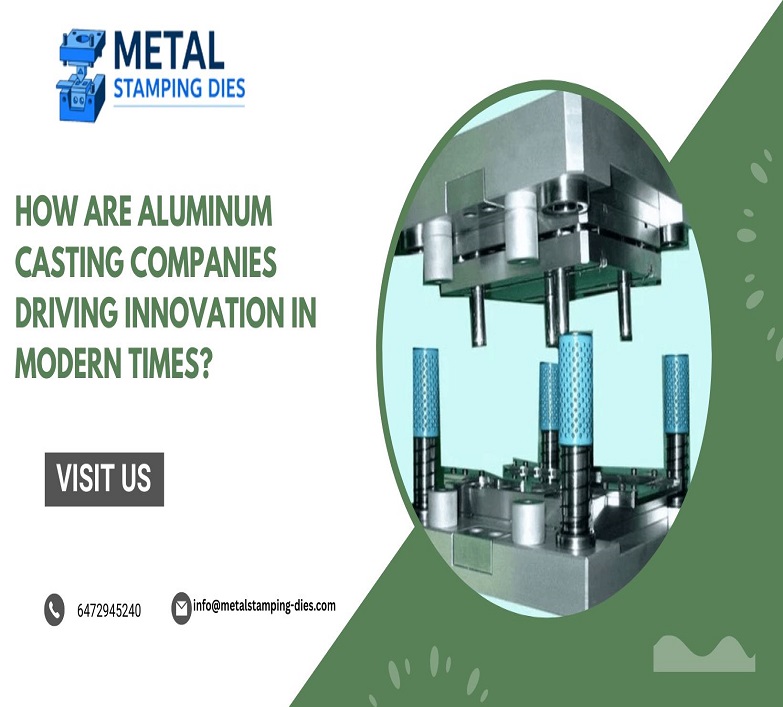

Metal forming technologies have evolved at an impressive pace. Modern aluminum casting companies now use advanced processes. These innovations have transformed what’s possible in part production today. The industry has moved far beyond simple sand casting methods. Precision, efficiency, and material properties have all improved substantially.
The automotive and aerospace industries push for higher performance standards constantly. Modern aluminum casting companies meet these challenges with remarkable solutions. Their innovations span every aspect of the casting process.
Advanced Casting Techniques Replacing Old Methods
The metal casting industry has changed in recent years. Many aluminum casting companies have invested in modern techniques. These advances allow for better quality products at faster production rates. The traditional sand casting still works for some applications but new methods offer distinct advantages. Many manufacturers have shifted to these innovative approaches with the best results.
1. High-Pressure Die Casting Revolutionises Production
The high-pressure die casting represents a major leap in manufacturing technology. Molten metal is injected into molds at very high pressure and speeds. This produces tight-tolerance and high-quality surface finishes on parts.
The cycle times are much shorter than conventional methods. Many companies can produce complex components in mere seconds with minimal waste.
2. Low-Pressure and Squeeze Casting Benefits
The low-pressure casting offers better metal density and fewer internal defects. The process slowly fills molds from the bottom up using pneumatic pressure. This minimises turbulence, as well as the undesired air pockets.
The squeeze casting combines the best aspects of forging and casting techniques. The result is parts with superior mechanical properties and structural integrity.
3. Semi-Solid and Vacuum-Assisted Innovations
Semi-solid metal casting involves semi-solidified aluminium to be used in order to achieve excellent results. The technique produces components that shrink less and have much smoother finishes.
Vacuum-assisted methods have also been adopted by the aluminum die casting companies. These systems remove gas porosity issues that plagued earlier casting methods. The thin-wall casting now produces components as slim as 1.5mm successfully.
4. 3D Printing Integration in Mold Making
The 3D printing and casting have transformed production timelines. Sand molds can now be printed in hours rather than taking weeks. This technology eliminates the need for physical patterns or traditional tooling.
The complex geometries that were once impossible have become routine projects. The binder jetting technology leads the industry in this exciting space.
Most aluminum die casting manufacturer facilities have adopted this approach for prototypes. The research and development timelines have shrunk by 60 per cent.
On-demand mold production has drastically reduced storage requirements and costs.
Small production runs have become economically viable for the first time. A large number of businesses can test-market new products without massive financial investments.
The rate of iteration gives a competitive advantage even in saturated markets. The designers can optimize the parts quickly depending on the testing data. Many digital workflows connect CAD models directly to the printing systems. The transition represents a fundamental shift in production.
New Alloy Development for Specific Industries
Material science advances continue to expand what’s possible in aluminium casting. The metallurgists work alongside engineers to create application-specific metal formulations. These alloy-specials are used to consider special challenges in various industries. One aluminum casting company in Wisconsin has pioneered several proprietary blends.
1. Automotive Sector Demands
The automotive industry requires aluminium-silicon alloys for modern engine blocks. The electric vehicle manufacturers need lightweight yet strong battery housings. These components must withstand thermal cycling and provide excellent conductivity.
Modern alloys deliver the perfect balance of weight and performance characteristics. The automakers depend on these advances for next-generation vehicle designs.
2. Aerospace and Electronics Applications
Many aerospace companies use aluminium-lithium alloys for weight-critical components. These special metals offer exceptional strength-to-weight ratios for flight.
The electronics manufacturers need high thermal conductivity for sophisticated heat sinks. These cooling components protect sensitive electronics from performance-limiting heat. These custom formulations can meet exact client specifications for any application.
3. Marine and Structural Solutions
The marine environments demand corrosion-resistant aluminium-magnesium alloys for obvious reasons. These metals stand up to harsh saltwater conditions year after year. Many structural components now use heat-treatable alloys for superior strength.
The tensile strength and fatigue resistance extend component lifespans. Tool and die in Calgary operations support these special production needs.
Simulation Software before Physical Production
Virtual testing has revolutionised how casting companies approach new projects. Software platforms predict exactly how metal will behave during production.
Many programs like MAGMASOFT, ProCAST, and Flow-3D lead the industry today. These advanced machines model fill patterns and solidification with incredible accuracy. These can detect the potential defects and correct them before cutting any metal.
Many aluminum casting companies save thousands through reduced trial-and-error cycles. The physical prototype costs have dropped by approximately 50 per cent overall. Many companies bring products to market faster than ever before. Digital optimisation of gating and riser designs improves yield rates.
- Virtual simulations identify potential failures before they happen
- Engineers can visualise the internal metal flow invisible in physical tests
- Temperature gradients throughout the mold appear in detailed colour maps
- Material properties can be adjusted digitally to find optimal formulations
- Production teams gain confidence before committing to tooling expenses
The technology allows for unprecedented control over manufacturing outcomes. This democratisation of technology has accelerated innovation across the sector.
The complex thin-wall castings undergo thorough digital verification first. Many aluminum die casting companies’ credit simulation tools for their success.
Quality Control and Testing Advancements
The current inspection systems also make sure that the castings are of precise specifications in all cases. The internal structures can be observed in X-ray and CT scanning at an incredible level of detail.
Such non-destructive tests define the defects that cannot be detected externally. The dimensional accuracy is checked up to the microns using the automated coordinate measuring machines.
The compositions of each batch of alloys are verified by spectroscopy. This ensures material consistency throughout large production runs. Advanced vision systems make 100% inspection a practical reality today. Many aluminium die casting manufacturer facilities use multiple inspection methods together. This virtually eliminates defective parts reaching customers.
The manufacturers have improved the traceability through QR codes and RFID tagging systems. Every component can be tracked from raw material to final installation. This data helps identify process improvements and potential problems quickly.
An aluminum casting company in Wisconsin pioneered several of these methods. Their quality control innovations have since spread industry-wide with the best results.
The combination of advanced techniques yields unprecedented product consistency. The customers receive parts that perform exactly as designed every time.
Manufacturing tolerances have tightened beyond what was possible a decade ago. Tool and die Calgary integrate these checks into production. The entire ecosystem of casting technology continues to advance rapidly.
Conclusion
The transformative changes in casting continue at a rapid pace. The advanced simulation software predicts outcomes with remarkable accuracy now. Material science developments create alloys with properties once thought impossible.
Sustainable practices are becoming standard across the industry today. The energy-efficient furnaces reduce both costs and environmental impacts significantly. The closed-loop water systems minimise waste in production facilities. These companies will continue leading manufacturing innovation for decades.
Many experienced metallurgists work alongside computer scientists and engineers daily. This collaboration creates solutions to long-standing manufacturing challenges effectively. Many companies that embrace these changes thrive in competitive markets.
Aluminium casting is changing how things are made today. These companies make parts that are light but strong, perfect for cars, planes and many other products. Want to learn more about how aluminium casting can help your business? Get in touch with our casting experts at (647) 294-5240 for a friendly chat about your needs. If you prefer email, drop your queries to info@metalstamping-dies.com.