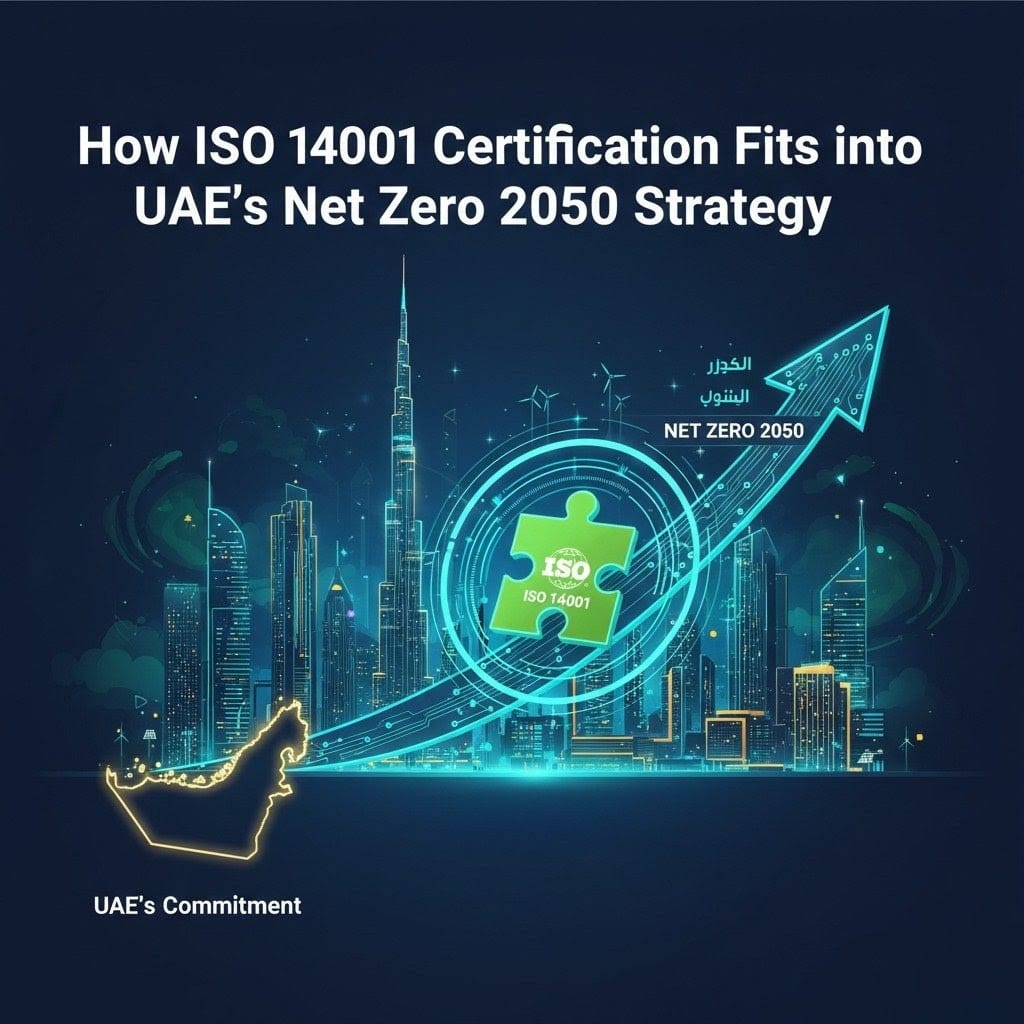

The UAE’s Net Zero 2050 Strategy is more than a national ambition—it is a transformation journey for every organisation operating in the country. ISO 14001, the world’s leading environmental management standard, gives companies a structured, practical way to turn climate commitments into measurable actions. This blog explores how ISO 14001 strengthens environmental responsibility and plays a crucial role in helping organisations contribute to the UAE’s national climate goals.
1. Introduction: UAE’s Climate Vision Needs Corporate Action
The UAE has stepped boldly into the global sustainability spotlight with its Net Zero 2050 Strategy. Yet achieving net zero is not something the government can do alone. It requires thousands of organisations across manufacturing, construction, logistics, retail, energy, and services to rethink how they use resources, manage waste, and reduce emissions.
For CSR, sustainability and ESG teams, the challenge is clear:
How do we turn good intentions into verifiable results?
This is where ISO 14001 becomes less of a “certificate” and more of a system for climate responsibility.
2. Why ISO 14001 Matters in the UAE Today
Sustainability is no longer a buzzword in the UAE. Businesses are now expected to:
- Meet tougher environmental regulations
- Present transparent ESG data to investors and banks
- Show real progress in sustainability reports
- Align with global supply chain demands
ISO 14001 offers a way to build environmental discipline—not just environmental awareness. It ensures sustainability doesn’t rely on a few passionate employees but becomes a part of how the organization works every day.
3. What ISO 14001 Really Requires (Explained Simply)
ISO 14001 might look complex on paper, but at its core, it asks businesses to do five things consistently:
- Know your environmental impact (energy use, waste, emissions, water, materials).
- Follow all environmental laws and regulations.
- Set objectives to improve performance.
- Set up effective mechanisms to reduce potential negative effects.
- Track your environmental results and refine them over time.
It is not about producing thick documents—it’s about building an environment-first culture.
4. How ISO 14001 Supports UAE’s Net Zero 2050 Strategy
a. Driving Carbon Reduction Through Resource Efficiency
Energy savings, water conservation, reduced wastage—ISO 14001 creates a roadmap for cutting emissions at the source.
b. Embedding Climate Risk Management
The UAE faces climate realities like rising temperatures and resource scarcity. ISO 14001 helps organizations integrate climate risks into operational planning.
c. Supporting Circular Economy Requirements
From material reuse to responsible procurement, ISO 14001 aligns closely with the UAE’s shift toward a circular economy framework.
d. Ensuring Compliance with UAE Environmental Regulations
Whether it’s MOCCAE guidelines, EAD requirements, Trakhees rules or Dubai Municipality’s environmental laws, ISO 14001 keeps organisations compliant consistently—not just during inspections.
e. Providing Reliable Data for Emission Strategies
If it’s not measured, it can’t be minimized.
ISO 14001 helps companies build accurate environmental KPIs that support GHG inventories and sustainability dashboards.
5. The Business Case: Why UAE Organisations Can’t Ignore ISO 14001
Beyond its climate benefits, ISO 14001 brings strong business advantages:
- Lower costs through reduced waste and energy consumption
- Better access to finance as banks increasingly consider ESG metrics
- Higher credibility with stakeholders and customers
- Stronger competitive positioning in UAE and global markets
- Simplified reporting for CDP, ESG disclosures and internal sustainability reports
For companies preparing for a low-carbon future, ISO 14001 is no longer optional—it’s foundational.
6. Practical Examples from the UAE Context
Here are realistic ways industries in the UAE use ISO 14001:
- Manufacturing reduces machinery energy use with ISO monitoring tools.
- Construction companies align ISO 14001 with Estidama and LEED requirements.
- Retail and hospitality use ISO systems to lower waste and improve recycling cycles.
- Logistics companies rely on ISO-based insights to refine route planning and lower fuel use.
These examples show how ISO 14001 transforms abstract sustainability goals into everyday operational improvements.
7. How CSR & ESG Teams Can Integrate ISO 14001 into Climate Strategy
- Map ISO 14001 objectives to company-wide sustainability KPIs.
- Rely on ISO-driven information to refine emissions reporting for all three scopes.
- Integrate internal audits into annual sustainability cycles.
- Use ISO 14001 outputs to strengthen ESG disclosure frameworks.
- Treat ISO as a continuous improvement engine, not a single certification task.
8. Simple Implementation Roadmap
A clear path for organisations starting the ISO 14001 journey:
- Environmental Gap Assessment
- Stakeholder Engagement & Planning
- Policy & Document Development
- Training & Operational Deployment
- Internal Audit & Management Review
- Certification & Ongoing Improvement
The roadmap is flexible and can be adapted for small businesses or large enterprises.
9. Conclusion: ISO 14001 as a Bridge to a Net-Zero Future
Though ambitious, the UAE’s Net Zero 2050 roadmap becomes achievable with suitable resources. ISO 14001 gives organisations a clear, structured way to take meaningful climate action, reduce their environmental footprint, and build trust with stakeholders.
For UAE businesses, implementing ISO 14001 goes beyond mere compliance. It’s about aligning with the country’s long-term journey toward a future where responsibility, innovation, and sustainability coexist.