
Dressing a newborn should feel joyful, not overwhelming. Yet most parents find themselves buried in piles of pink and blue, half of which go unworn. There’s a smarter way to build a baby wardrobe, and it starts with simplicity.
Why Parents Are Rethinking the Traditional Baby Wardrobe
The old approach – separate wardrobes for boys and girls – creates more problems than it solves. You buy double the items, store twice the clutter, and end up donating half of it before the season ends.
Most parents don’t realise how quickly gendered wardrobes spiral. A well-meaning relative buys pink. Another brings blue. Before the baby arrives, you’re sitting on a mountain of clothing in two completely separate color stories, most of which won’t fit at the same time and half of which won’t suit the season you’re actually in.
A wardrobe built on neutral, versatile pieces simply works better. It’s practical, flexible, and far less stressful to manage day to day. When everything coordinates, getting dressed stops being a decision and starts being easy.
The Case for Going Neutral From Day One
Choosing a gender neutral newborn outfit early on gives you real flexibility. You’re not locked into a color palette. You’re not scrambling to exchange gifts. And if you have another baby down the road, every piece still works.
This is especially useful for parents who don’t find out the sex before birth. Instead of waiting and panic-shopping in the final weeks, you can build a complete, beautiful wardrobe well in advance. Everything you buy is useful from day one, regardless of what happens in the delivery room.
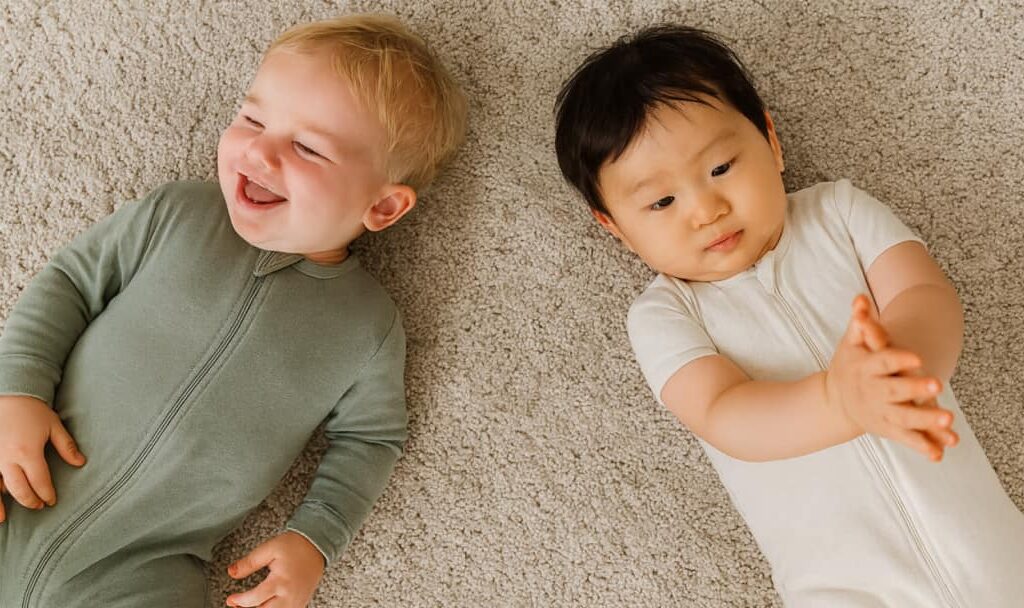
Neutral knit rompers, beanies, and booties in soft whites, creams, and muted tones layer beautifully together without any effort. There’s no clash, no mismatch, and no decision fatigue when you’re running on three hours of sleep and need to get out the door.
What to Look for in a Neutral Newborn Piece
Not all neutral clothing is created equal. The color is just one part of the equation. The fabric, construction, and fit matter just as much – especially for a newborn whose skin is sensitive and whose size changes every few weeks.
When shopping, keep these in mind:
- Fabric first – 100% soft cotton is gentler on newborn skin than synthetic blends. It breathes naturally and doesn’t trap heat or cause irritation
- Fit matters – Look for slightly stretchy knit fabric that moves with the baby. Stiff or structured fabric makes dressing and undressing unnecessarily hard
- Versatility – Can it work for everyday wear and photos alike? The best pieces do both without needing to be dressed up or down
- Durability – Heirloom-quality pieces survive multiple washes without losing shape, pilling, or fading. Cheap jersey fabric doesn’t
It’s also worth thinking about closures. Snap fastenings at the bottom make diaper changes far easier than pull-on styles, especially during nighttime changes when everyone is half asleep.
Neutral Doesn’t Mean Boring
One of the biggest myths about neutral baby clothing is that it looks plain. Parents sometimes worry that stepping away from prints and bright colors means ending up with something dull. The opposite is actually true.
Textured knits, cable patterns, and ribbed finishes add visual depth without relying on color or character prints. A cable knit romper has far more visual interest than a flat jersey onesie covered in cartoon animals. The craftsmanship does the work that the print would otherwise try to do – and it does it far more elegantly.
A well-made knit romper with a matching beanie looks polished in photos and comfortable enough for a Tuesday afternoon at home. That combination – photo-ready and genuinely wearable – is what separates quality neutral knitwear from everything else on the market.
Brands like Brave Little Lamb have built their entire range around this idea. Designed in Australia and made from 100% soft cotton, their pieces use texture and craftsmanship to create clothing that looks considered and timeless rather than trendy and temporary.
How Neutral Clothing Holds Its Value
There’s a financial argument here that’s easy to miss. A quality neutral piece bought for a first child doesn’t stop being useful when that baby outgrows it. It can be stored and used again for a sibling, passed on to a friend with a new baby, or kept as a keepsake.
Compare that to a pile of gender-specific, season-specific, trend-specific pieces that have a lifespan of a few weeks and nowhere useful to go afterward. The cost per use on a quality neutral piece is far lower than it looks on the price tag.
Building a Capsule Newborn Wardrobe
Start small and intentional. The goal is a wardrobe where every piece works with every other piece, covering every situation without excess.
- 3-4 knit rompers in neutral tones
- 2-3 beanies that coordinate easily
- A soft blanket that doubles as a photo prop
- A pair of booties for cooler days
- One or two knit bodysuits for layering
That’s genuinely all you need for the first few months. Everything fits in one drawer, everything goes together, and nothing gets wasted. When the next size up is needed, you repeat the same simple formula.
The stress-free baby wardrobe isn’t a myth. It just requires starting with the right foundation.
FAQ
Q: Are gender neutral newborn clothes only available in white and grey?
Not at all. Neutral palettes include warm creams, oatmeal, sage green, and dusty mauve – tones that work beautifully on any baby and photograph far better than stark white.
Q: Can gender neutral outfits work for newborn photography?
Yes – soft, textured knits in neutral tones are actually preferred by many newborn photographers because they don’t distract from the baby. The texture adds depth without competing with the subject.
Q: Are neutral baby clothes more expensive than standard baby clothes?
Quality neutral pieces can cost more upfront, but they’re typically better made, last longer, and can be reused for future siblings – making the overall cost lower than buying cheaper gendered pieces repeatedly.