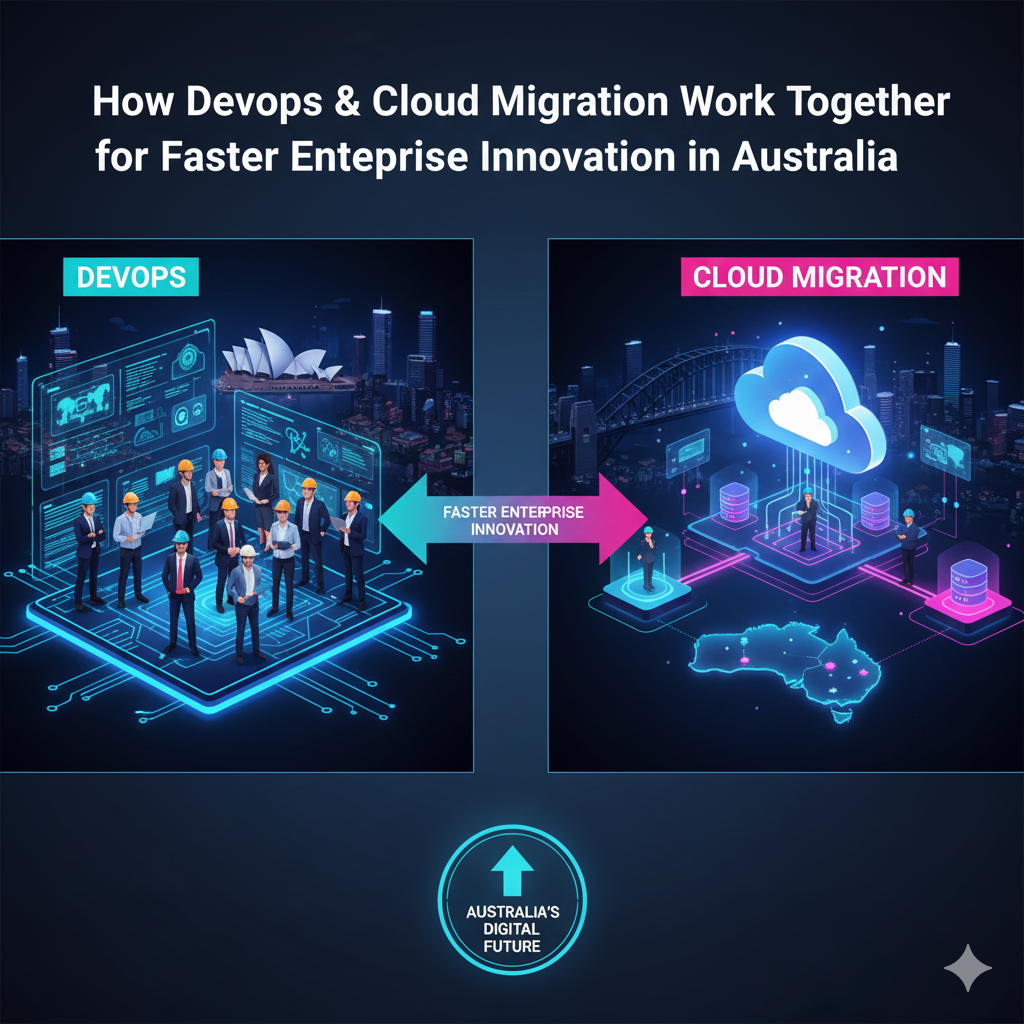

In today’s rapidly advancing digital landscape, Australian enterprises are under constant pressure to innovate, modernize systems, enhance customer experiences, and stay competitive. As organizations scale, traditional development models often fail to keep pace with changing market demands. This is why DevOps and cloud migration have emerged as two of the most transformative enablers of enterprise innovation across Australia.
When adopted together, DevOps and cloud transformation help Australian businesses accelerate deployment cycles, reduce operational costs, and build more flexible, resilient digital ecosystems. Whether you’re a mining enterprise in Western Australia, a fintech startup in Sydney, or a government agency embracing modernization, combining cloud migration with DevOps practices can be a game changer.
This article explores how DevOps and cloud migration complement each other, why they matter for Australian enterprises, and how organizations—often supported by a mobile app development company in Australia—can leverage both to innovate faster and smarter.
1. Why DevOps and Cloud Migration Are Reshaping Australian Enterprises
The shift to cloud computing has been growing steadily across Australia, especially with the expansion of local data centres from AWS, Microsoft Azure, and Google Cloud. Simultaneously, DevOps has emerged as a crucial framework to break silos, improve collaboration between development and operations, and speed up deployment cycles.
When combined, DevOps + Cloud deliver benefits such as:
- Faster release cycles
- Lower operational overhead
- Increased collaboration between teams
- Better resource utilization
- Automated workflows and infrastructure
- Higher security and compliance standards
- Rapid scaling capabilities
- Enhanced innovation and experimentation
Australian businesses across industries—from banking to healthcare, logistics to retail—benefit when both are implemented together.
2. DevOps: A Deep Catalyst for Enterprise Modernization
DevOps stands for Development + Operations. It focuses on continuous integration, continuous delivery (CI/CD), automation, and breaking communication barriers between teams.
Core principles of DevOps that help Australian enterprises innovate faster:
- Automation: Reduces human error and speeds up processes.
- Continuous Integration/Continuous Deployment: Enables rapid releases and frequent updates.
- Monitoring & Observability: Improves system reliability.
- Collaboration: Developers and operations teams work with shared goals.
- Agility: Faster adaptation to business and market needs.
Australian enterprises that adopt DevOps report shorter development cycles and dramatically improved operational efficiency.
3. Cloud Migration: The Foundation of Modern Digital Infrastructure
Cloud migration refers to shifting applications, data, and workloads from on-premise environments to cloud platforms like AWS, Azure, and Google Cloud.
Benefits of cloud migration for Australian enterprises:
- Cost efficiency: Pay only for what you use.
- Scalability: Scale up or down based on demand.
- Improved disaster recovery: Built-in redundancy.
- Strengthened cybersecurity: Cloud providers meet Australian compliance standards.
- Better integration with modern tools: Enables microservices and automation.
- Reduced IT maintenance overhead
The cloud offers a flexible backbone for enterprises to adopt emerging technologies such as AI, ML, IoT, and automation.
4. How DevOps and Cloud Reinforce Each Other
DevOps and cloud migration are not separate initiatives; they are interdependent. The cloud provides the infrastructure flexibility and automation required for DevOps to thrive, while DevOps maximizes the potential of cloud platforms.
A. Cloud Enables DevOps Success
- On-demand environments support CI/CD pipelines.
- Infrastructure-as-Code (IaC) makes deployments reproducible.
- Automated provisioning speeds up development.
- Cloud security tools integrate seamlessly with DevOps pipelines.
B. DevOps Maximizes Cloud Value
- Automated workflows reduce cloud waste and cost overruns.
- Continuous delivery enables faster cloud-native application updates.
- Monitoring tools improve cloud performance management.
- DevOps removes friction in multi-cloud or hybrid-cloud environments.
Together, they create a high-performance ecosystem that supports rapid innovation.
5. Key Areas Where DevOps & Cloud Drive Innovation in Australia
1. Faster Product Development
With cloud-based infrastructure and DevOps automation, enterprises can roll out new features or updates weeks—or months—faster.
This is particularly valuable for:
- fintech apps
- mining automation software
- logistics and fleet management systems
- healthcare digital platforms
- retail mobile apps
Many organizations collaborate with a mobile app development company in Australia to build cloud-native and DevOps-driven digital products.
2. Cost Reduction & Resource Optimization
DevOps practices like automated scaling, real-time monitoring, and continuous optimization reduce cloud costs significantly.
Combined with a cloud-native environment, businesses achieve:
- lower operational costs
- fewer infrastructure failures
- optimized resource usage
3. Enhanced Security & Compliance
Australian businesses must comply with:
- the Australian Privacy Principles (APP)
- APRA CPS 234
- ASD Essential Eight
- industry-specific cybersecurity regulations
Cloud platforms offer built-in compliance tools, while DevOps integrates continuous security (DevSecOps) across the pipeline.
4. Improved Reliability & System Uptime
Cloud infrastructures paired with DevOps monitoring tools improve:
- server uptime
- load handling
- disaster recovery
- fault detection
This helps enterprises in high-stakes sectors like finance, healthcare, and government.
5. Better Collaboration Across Teams
DevOps aligns different departments—development, QA, operations, security—while the cloud ensures these teams work on the same scalable environment.
This leads to:
- increased transparency
- faster problem resolution
- improved organizational efficiency
6. Use Cases: How Australian Enterprises Benefit
A. Government Agencies
Adopting DevOps and cloud migration helps government agencies modernize legacy systems and improve digital service delivery.
B. Financial Institutions
Banks use DevOps and cloud tech to build secure digital banking services and roll out new features quickly.
C. Retail & E-Commerce
Cloud and DevOps allow businesses to scale during peak periods and optimize mobile shopping apps.
D. Healthcare
Hospitals and eHealth platforms leverage both to ensure secure data storage, telehealth services, and high system reliability.
E. Mining & Energy
With IoT and AI integrations, cloud + DevOps enable real-time monitoring and automation.
7. Best Practices for Implementing DevOps & Cloud Migration in Australia
1. Start With a Cloud Readiness Assessment
Evaluate legacy systems, cost implications, compliance needs, and data sovereignty.
2. Build a DevOps Strategy
Define:
- CI/CD pipelines
- monitoring tools
- automation targets
- roles and responsibilities
3. Adopt Infrastructure-as-Code (IaC)
Use tools like:
- Terraform
- AWS CloudFormation
- Azure ARM Templates
IaC ensures consistency and reduces manual configuration.
4. Implement DevSecOps
Security must be integrated into every stage of development—not added later.
5. Use Managed Cloud Services
This helps enterprises focus on innovation instead of infrastructure maintenance.
6. Modernize Using Microservices
Break monolithic applications into microservices to speed up development.
7. Partner with Specialized Development Companies
Collaborating with a mobile app development company in Australia helps enterprises build cloud-native, DevOps-ready digital ecosystems faster.
8. Why Partnering With Experts Matters
DevOps and cloud migration require:
- deep technical expertise
- strong understanding of compliance regulations
- knowledge of Australian market needs
- experience with modern cloud architectures
A skilled development partner helps organizations transition smoothly, avoid downtime, and maximize their ROI.
Final Thoughts
DevOps and cloud migration are more than technology upgrades—they are strategic investments that enable Australian enterprises to innovate faster, operate smarter, and stay future-ready.
Together, they unlock:
- rapid deployment cycles
- lower costs
- improved reliability
- enhanced security
- stronger digital experiences
Enterprises that embrace both are better positioned to compete in a digital-first Australia.