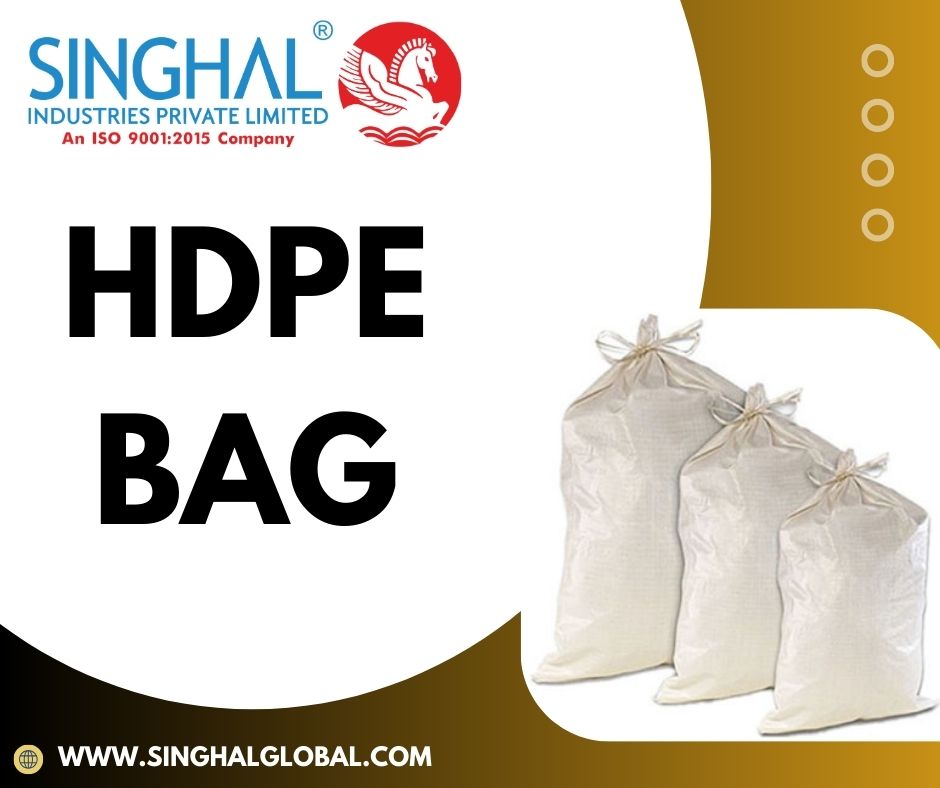

The complex mechanisms of worldwide trade and industry are reliant on packaging that is not only a container but also a fortress in itself. From far-off construction sites to high-speed automated bottling plants, the output of industries is protected in sturdy and durable bags. High-Density Polyethylene (HDPE) woven bags are those that have been kept in dark but are very loud in their existence, a heavy-duty packaging that is capable of enduring a harsh nature of the surroundings, a tough logistics scenario, and a heavy payload challenge.
Unlike the regular plastic that you find in your grocery bags, these woven sacks are mostly designed to contain a standard 50 kg plastic bag load and thus are engineered to provide absolute performance.
How the Plastic is Engineered for Longevity
When it comes to the heavy-duty plastic bags, the best choice is definitely HDPE due to its more robust microbial structure. It’s a polymer consisting of long, mainly unbranched polymer chains, which results in a very dense and less permeable material. The end result for this material is a fabric that, as a result of the extrusion of the plastic film into flat tapes and then weaving it, has a remarkable tensile strength, is resistant to punctures and has a large strength-to-weight ratio. The strength upgrading of the sack made from plastic film that was simply cut into pieces for the holding of granular, powdered, and flaked materials without the plastic being torn or burst, is due to the weaving operation. The production process of the sack, which is handled by a factory making plastic bags, involves the very exact control of the weaving and the denier (the linear mass density of the fiber) in order to get the strength that is necessary for the industrial applications.
Industrial Powerhouses Where It Plays
These sturdy HDPE woven sacks have become an absolute necessity in many industrial sectors that have been using paper or lighter plastic sacks which would have failed them in the past.
Agriculture and Fertilizers
In the case of agriculture, it is crucial that the bags not only be impermeable to moisture, but also able to guard against any other atmospheric elements when they are stored or are being transported in a humid environment. This is a role that is adequately fulfilled by the coated HDPE bags for seed, animal feed, and fertilizers, and the high burst strength feature certainly adds to that. Furthermore, in the event of dropping or throwing and the consequent impact during the loading and unloading processes, the good burst strength feature will definitely help keep the bag intact and hence the great contents safe, particularly when it comes to the plastic bag 50 kg most commonly used in the transportation of farm inputs worldwide.
Construction and Minerals
The packaging of the construction and mining industries’ demands – the likes of cement, aggregates, sand, and fine mineral powders – could indeed be the most difficult ones. What these materials have in common is their abrasiveness, weight, and the fact that they need to be put in bags that are resistant to the tearing caused by rubbing against other surfaces or being stacked. The 50 kg plastic bag Singhal Industries Pvt Ltd that is made to serve such a purpose is often equipped with an inner lining or a layer that prevents not only the leaking of the fine powder but also enhances its resistance to moisture. The sturdiness of this kind of packaging is a non-negotiable factor as far as job-site durability is concerned.
Beyond Strength: Customization and Features
Today, the heavy-duty HDPE bags are highly evolved and diverse in their features and applications. The foremost Plastic bag manufacturer allows for far-reaching personalization options besides size and color only. To achieve firm pallet stacking, an anti-slip coating is applied while a stabilizer is used to prolong the life of the bag material when exposed to sunlight in cases of long storage outdoors. A gusseted bag bottom makes the bag stand vertically and thus saves warehouse space as well as enhances the storage presentation. By using advanced printing techniques, great branding, and product information can be shown clearly and effectively, creating a win-win situation for both the marketer and his primary partner, the reliable container.
Quality Assurance and Manufacturing Standards
The reliability of these bags is basically from the quality control that the manufacturer has done. A firm like Singhal Industries Pvt Ltd, for example, employs cutting-edge machines along with very strict quality-testing protocols in order to have every sack fulfilling industrial standards regarding the capacity of weight-bearing and tear strength. Their scrupulousness is very important because, in a logistics chain, the rupture of just one bag can cause a serious loss of goods and contamination.
The same level of quality that can be found in their industrial products is also noticeable in their other product ranges, for instance, the special textile needed for the Singhal Landscape Geotextile, which is a clear demonstration of the wide-range application of their polymer expertise.
Singhal Industries Pvt Ltd is converting raw polymer granules into high-quality 50 kg plastic bags through advanced manufacturing processes.
Conclusion
The heavy-duty HDPE bag is one of the main characters of industrial and commercial activities, performing the role of the first line of defense for pretty much any kind of products either in transit or storage. What makes it inherently strong is the existence of very advanced customization options such as lamination and protection that put it in the position of the most suitable packaging solution for high-volume, challenging materials.
On the one hand, the specialized plastic bag manufacturer helps with the protection of the agricultural yields, while on the other hand, it contributes to the security of construction materials. Thus, the Plastic 50 kg bag is resulting in not only supply chain process efficiencies but also loss minimization and assurance of product integrity, which altogether is the basic condition for the dependability of the entire supply chain.
Frequently Asked Questions (FAQs)
Q: What kind of material is generally used for the creation of a heavy-duty HDPE bag and what is the reason?
A: High-density polyethylene is the primary material used. It is used because the long, unbranched chains of the molecules give the woven fabric made from it very high tensile strength, excellent resistance to puncture and effective protection from moisture.
Q: What does the term “woven” stand for when we talk about HDPE bags?
A: The term “woven” refers to gathering the HDPE tapes that are separately melted and extruded and then the tapes are interwoven in a crisscross manner, similar to cloth. This mesh technique greatly contributes to the strength of the bag and hence its ability to carry a heavier load compared to a simple plastic film bag.
Q: How is a normal plastic 50 kg bag that is made of woven material kept safe from moisture?
A: In order to stop moisture from getting in through the woven gaps, the bags are usually given a coat or “laminated” with an LDPE or film layer, or they are provided with a loose inner liner, thus forming a perfect barrier.
Q: What does stabilization in HDPE bags mean and why is it significant for industrial use?
A: stabilization is an additive that is blended with the HDPE material during the production process to stop the plastic from rotting, cracking, and losing its strength when exposed to the sun for extended periods of time during outdoor storage.
Q: What are the major industrial contents that are generally packed in a 50 kg plastic bag manufactured by Singhal Industries Pvt Ltd?
A: These bags are mainly utilized for the large-volume, heavy, and abrasive materials such as cement, fertilizers, agricultural products (grains, feed), sugar, sand, and different chemical powders.
Q: In what way does a plastic bag manufacturer keep the bag strength at a consistent level?
A: Manufacturers employ very advanced quality control which involves continuous monitoring of polymer melt flow, very accurate control of the tape denier, and constant checking of the tensile and burst strength of the final products.
Q: Who is largest supplies of HDPE bags?
A: The Singhal Industries Pvt Ltd biggest suppliers are large multinational technical textile and geosynthetic companies operating worldwide and having a strong production base in countries like China and India, where numerous big-scale bag suppliers are located.
Q: Who is the largest exporter of HDPE bag?
A: The top exporters globally are the U.S., Vietnam, and Malaysia, whereas India is a prominent exporter, with companies such as Singhal Industries Pvt Ltd that make a significant contribution to the international supply chain besides their production of specialized products like the Singhal Landscape Geotextile.
Q: Who is the largest manufacturer of HDPE bag?
A: China is the largest manufacturer in the world for plastic bags by volume. India is also a major manufacturing hub for woven bags. Singhal Industries Pvt Ltd is a leading manufacturer in India that produces a wide range of industrial plastic packaging including heavy-duty HDPE sacks.