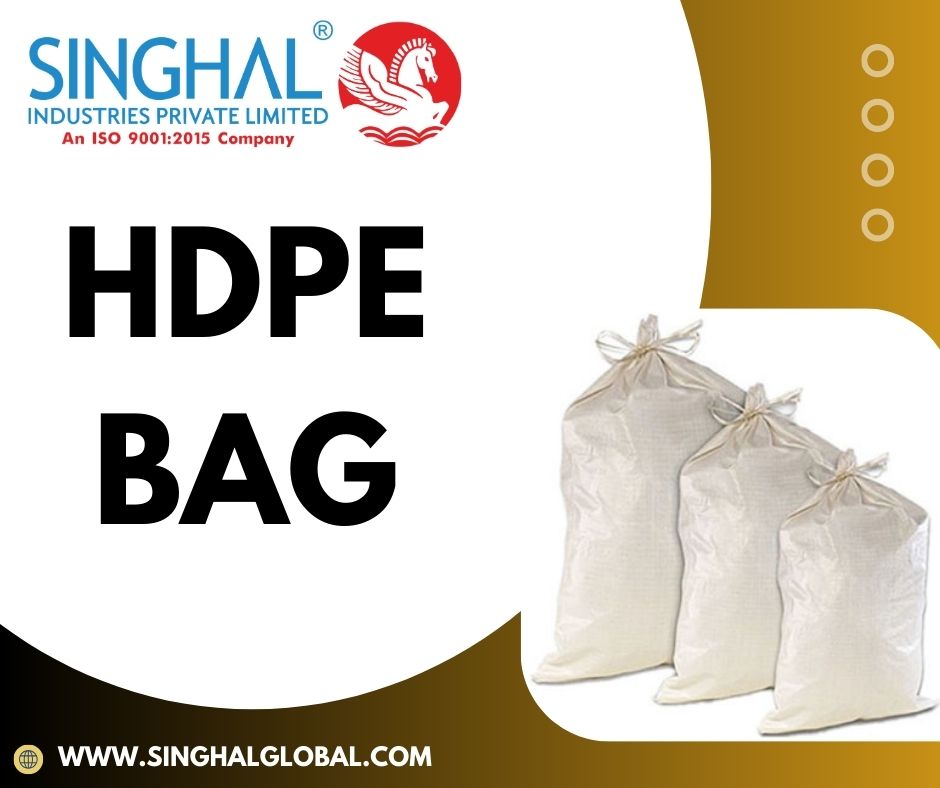

In the incredibly complex supply chain system of the world, where goods as varied as agricultural produce and fine chemical powders need to be transported and stored not only in a safe and efficient way but also in an affordable manner, the choice of packaging becomes the most important factor. High-Density Polyethylene (HDPE) bags have become the foremost answer to bulk material handling needs thus, are leading the way to a gradual phasing out of the use of traditional materials such as jute and paper sacks. HDPE, a thermoplastic polymer obtained from petroleum, is the single strongest argument for the winning combination of a business that seeks to be at once profitable yet environmentally conscious: the three factors that are pushed forward by this material, i.e., its strength, moisture resistance, and cost-effectiveness, cannot be overlooked by any company. A single plastic 50 kg bag for rice or a large sack for cement, manufacturers from all walks of life turn time and again to this long-lasting material that assures them tough industrial conditions will not result in substandard performance.
Durability and Strength: The Core Advantage
The key to the massive use of HDPE bags is their mechanical superiority over other types of packaging. HDPE is essentially a material with a high strength-to-density ratio and, therefore, is tough and durable even when made of a lightweight, thin film or woven fabric. This inborn strength is instrumental when it comes to bulk items, in particular, those packaged in the standard, heavy-duty size such as a Plastic 50 kg bag.
The most popular type is the HDPE woven sack, the production process of which involves the weaving of flat strips of HDPE film into a durable fabric. Such a woven structure gives the product extremely high tear resistance and, at the same time, a very high level of load-bearing capability, which in turn, greatly diminishes the risk of product loss due to the occurrence of tearing in the handling, stacking, and shipping phases. Furthermore, the bags are subjected to the harshest of treatments, repeated loading and unloading, and long haul, thus making them an essential tool in the transportation of such materials as fertilizers, cement, food grains, and animal feed.
Moisture Resistance and Product Protection
In contrast to paper or natural fiber bags, HDPE is a polymer that offers excellent resistance to moisture and chemical ingress. More often than not, these are the kinds of commodities are being packaged in bulk that suffer in the face of the different sources of humidity, be it some regular rainfall or terrestrial condensation. An HDPE bag is a safe haven for food and other goods from the ravages of the elements.
To make this protective feature even better, a lot of HDPE bags additionally get covered with a thin layer of polyethylene film which, when sealed, becomes completely impermeable. For example, a quality 50 kg plastic bag Singhal Industries Pvt Ltd is frequently laminated not only to prevent the escape of tiny powders but to keep the product perfectly dry for the purpose of quality retention and shelf life extension, which is a very decisive component of export-oriented businesses. The feature in question plays an active role in the prevention of spoilage and in ensuring compliance with tight quality standards.
Cost-Effectiveness and Manufacturing Efficiency
Proper packaging cost management in the case of a business with significant volume will almost certainly be the factor that tips the scales and causes profits to rise. HDPE is not an expensive material to produce, and weaving many sacks at once is a process that is quite automated and easily scalable, thus Factory that makes plastic bags nowadays is a cutting-edge facility that is very efficient in converting HDPE granules into tapes, weaving the tapes into fabric, and finally cutting and stitching the fabric into ready-made bags
This efficiency in manufacturing is directly responsible for the end-user enjoying low costs per unit. In addition, the fact that HDPE bags are lightweight even when they have been produced to hold a plastic 50 kg bag considerably lowers the freight charges when compared to packaging that is heavier and bulkier. What is gained through such cost-saving then goes on multiplying across numerous large consignments, thus the final packaging cost turning out to be a very competitive one.
Customization, Printing, and Branding
Packaging is not just a vessel; it is a moving ad for the brand. HDPE bags provide excellent surface quality for high-definition, multi-color printing. This means that companies can utilize their bulk packaging as a means of branding, adding product information and regulatory markings. A Plastic bag manufacturer can change the size, color, weave density, and printing details of a plastic bag to suit any customer’s needs, be it a simple corporate logo or a complex nutritional information.
Being able to visually communicate in a consistent and top-notch manner is a powerful marketing weapon. In a market where trust and brand loyalty are key, a well-printed and durable 50 kg plastic bag Singhal Industries Pvt Ltd not only maintains but even elevates the product’s quality image to intermediaries as well as end users.
Versatility Beyond Bulk Packaging
Even though their principal function is that of heavy-duty packaging, the materials used for HDPE have properties that can be utilized in various industrial and civil projects. As a matter of fact, the same polymer technology that is used to make tough woven bags is also the base technology for products that are used in civil engineering and environmental protection, for example, the Singhal Landscape Geotextile. This geotextile fabric made out of either durable polypropylene or high-density polyethylene, is a perfect example of the material’s inherent qualities of being structurally strong and holding up well against the elements, hence, revealing the material’s versatility produced and engineered by companies like Singhal Industries Pvt Ltd. The latter duality illustrates that the materials which are selected by the leading plastic bag manufacturer companies are, at their core, versatile enough for different types of tough jobs.
Conclusion
The continuous choice of HDPE bags as bulk packaging means for the fields of agriculture, chemicals, construction, and consumer goods, tells us a lot about the polymer being an ideal balance between mechanical, protective, and economic advantages. From the very high load-carrying capability of a well-made 50 kg plastic bag to the perfect moisture barrier and low production cost, HDPE woven sacks have a very strong value proposition which conventional packaging cannot even come close to. Companies that care about product safety, brand image, and cost management in their supply chain, cannot make a better decision than to collaborate with a reliable plastic bag manufacturer such as Singhal Industries Pvt Ltd for their sturdy 50 kg plastic bag Singhal Industries Pvt Ltd needs, if they want to be sure that their products will be transported safely and in an efficient manner anywhere in the world.
Frequently Asked Questions (F&Q)
Q: What materials is the HDPE plastic bag made of?
A: The major material is High-Density Polyethylene, which is a thermoplastic polymer derived from petroleum and is mainly recognized for its high strength-to-density ratio.
Q: What advantages do woven HDPE bags have over simple plastic films in bulk packaging?
A: The main reason for the improved tensile strength and tear resistance of the woven fabric is the stronger chain of the fibers, this is why the woven bags are able to carry heavy bulk items like the plastic 50 kg bag and can be stacked and transported without tearing.
Q: In what ways does the HDPE bulk bag improve with lamination?
A: Lamination coats the bag with an impermeable film layer that is waterproof, dust free, and provides excellent printing capabilities.
Q: What are some regular goods that are packed in 50 kg plastic bags at Singhal Industries Pvt Ltd?
A: These include cement, fertilizers, sugar, food grains (rice, wheat), polymers, and different kinds of industrial powders.
Q: Are HDPE plastic bags designed for reuse or are they recyclable?
A: HDPE is a plastic that is very easy to recycle (resin code #2). A lot of industrial bags are made with the intention to be used once, but then recycled, and there are some heavy-duty bags that can be reused.
Q: What is the normal holding capacity of HDPE woven bags?
A: HDPE woven sacks are made for various holding capacities from 5 kg to even more than 100 kg, but 50 kg plastic bags are the common industrial standard.
Q: How important is a plastic bag manufacturer to the supply chain?
A: The plastic bag manufacturer that a company can depend on not only provides good quality, affordable and productive packaging but also promotes supply chain efficiency through less product damages and losses in storage and transport.
Q: Who is the largest Suppliers of Hdpe bag ?
A: The Singhal Industries Pvt Ltd is biggest suppliers in the world are often well-established manufacturers situated in Asia, in particular in countries such as India and China, who have large production capabilities.
Q: Who is the largest exporter of Hdpe bag?
A: Countries like India and China are the biggest like Singhal Industries Pvt Ltd is exporters of HDPE bags, fulfilling the demands of the industrial and agricultural sectors globally.
Q: Who is the largest manufacturer of Hdpe bag?
A: Major manufacturers are typically large plastic and woven sack producers that are vertically integrated and are located in Asia. Indian companies such as those that also manufacture polymer-products like the Singhal Industries Pvt Ltd, are among the prominent global players in this field.