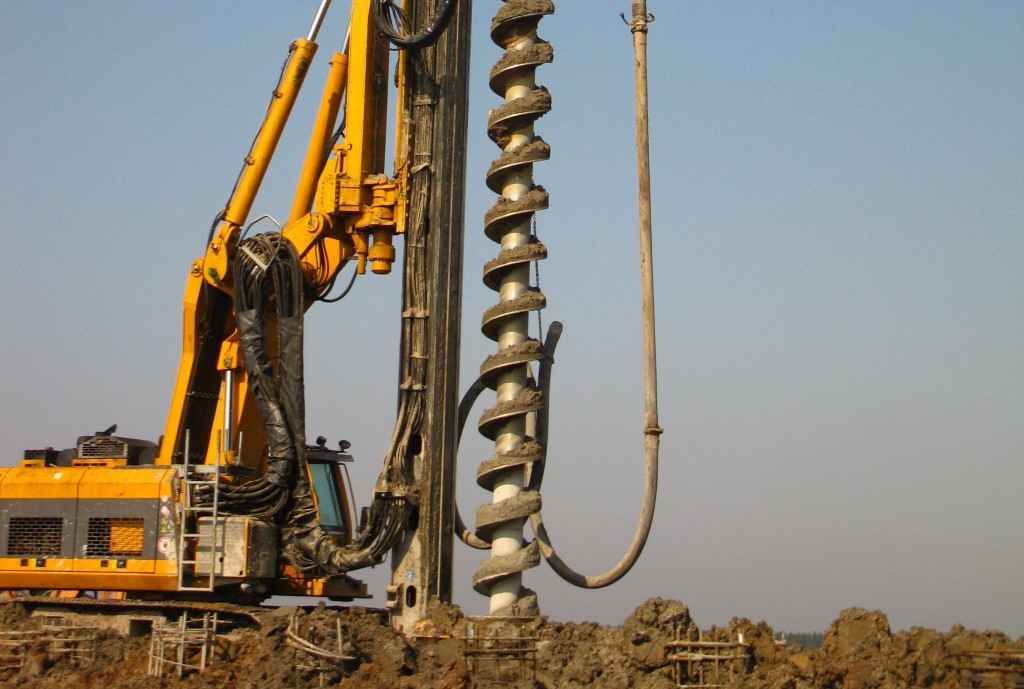

Foundation issues can often be the most significant, unavoidable construction problem. Good, solid, load-distributing foundations are critical for any building. One of the best foundation techniques is bored piling, as it allows for deep, stable foundations even in difficult ground conditions. The speed and usability of a bored piling machine are very much determined by the performance of the bored piling equipment, which will adequately drill the perfect hole and appropriately transfer the load. This equipment gives modern construction the precision and stability it demands.
What Is Bored Piling?
Bored piling is the process of drilling a deep hole into the ground and forming a pile by filling the hole with reinforced concrete. A pile can help transfer the weight of a building from weaker surface soils to a stronger layer between roughly 10 and 30′-0″ below the surface of the earth, at which point a strong foundation is typically found.
Bored piling is silent and free of vibrations, which is often an acceptable practice in urban projects where minimizing disturbance is a priority. Additionally, bored piling provides greater flexibility in design for foundations being placed in poorer soils.
How it Works:
The process begins when a rotary drilling rig drills a cylindrical bore. Depending on the soil type and composition of the drilling mud, the borehole is either temporarily cased or held open with drilling fluids to prevent collapse.
Once at the proper depth, a steel cage is inserted into the bore, followed by the pouring of concrete, resulting in a hard, solid pile. Strict adherence to the engineering process results in precision and control in creating a strong, stable, and reliable deep foundation system for buildings and structures.
Primary Components of Bored Piling Machinery:
Contemporary bored piling systems utilize cutting-edge apparatus designed for precision and operator safety.
- Rotary Drilling Rig: The principal machine that bores into the ground with varying torque and depth control adjustments.
- Kelly Bar: Transfers energy from the rig to the drilling device for deeper excavations.
- Drilling Tools: Such as augers and buckets, are employed based on soil type.
- Casing and Tremie Pipes: Support bore stability and provide for smooth concrete placement.
Each element of this system works in tandem to provide reliable quality in any ground conditions.
Benefits of Modern Piling Technology:
Modern technology involved with bored piling machinery provides many advantages to construction projects. The machines are quieter, reduce vibration, penetrate deeper, and install faster and cleaner.
Digital control systems provide much more accurate results and reduce operator error. New technology has created an efficient and more environmentally-friendly process.
Applications of Bored Piles in Construction:
Bored piles are used in the construction of bridges, high-rise buildings, and retaining structures. When placed in side-by-side configurations, bored piles can form a bored pile wall to support the soil during excavations and for slope stabilization. This versatility makes bored piles a popular option when deep and reliable foundations are needed for projects.
Safety and Maintenance:
Safety and efficiency highly depend on proper maintenance and trained use of equipment. Regular inspections and using tools correctly during construction, along with following safety procedures, assist in getting the maximum life and performance from your equipment. Safe and maintained equipment or tools also minimize time on the construction site.
Choices of Piling Equipment & Job Conditions:
The decision of which type of piling will be driven by site conditions, the job scale, and site requirements. For example, soft soils may require the use of stabilizing fluids; on the other hand, working with hard rock cases will require a more rigid drilling rig setup. These are
all important in relation to issues related to efficiency, expensive installations, and structural safety.
Conclusion:
As discussed, bored piling is certainly one of the most reliable foundation techniques of our modern time. Quality equipment and skilled productivity lead to better-engineered structures that are both safer and more effective for the life of the facility. Bored piling continues to play a major role in the foundation of the built environment, more so as more advanced technologies are being implemented to create higher degrees of precision and reliability.