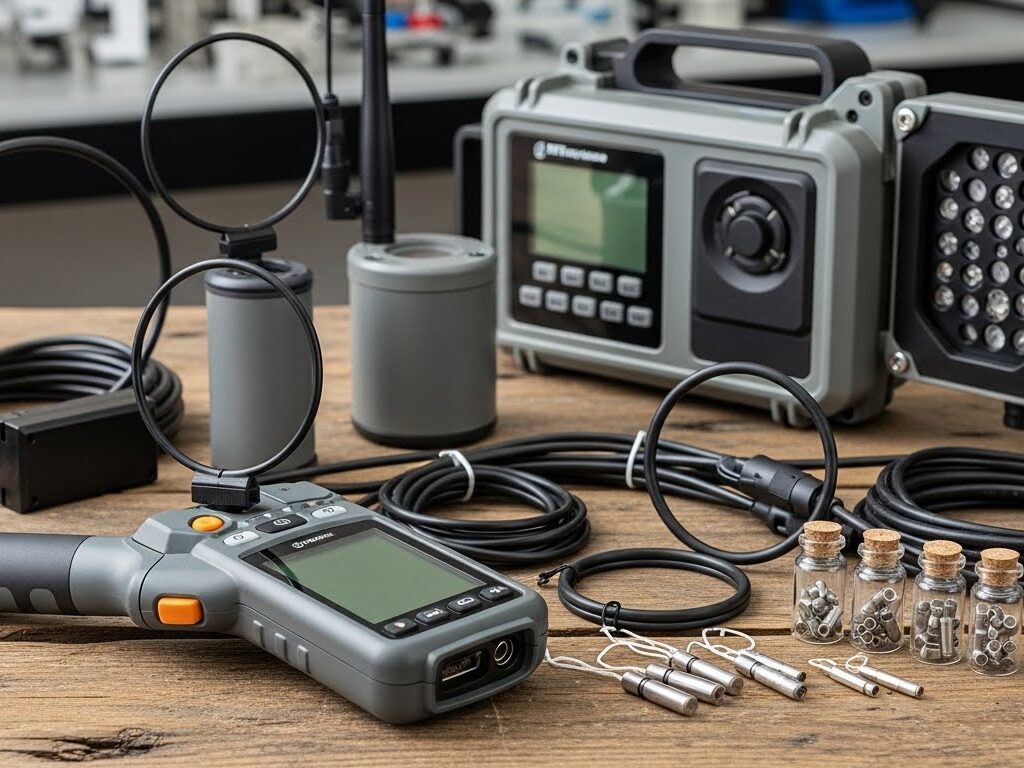

The quest to understand aquatic ecosystems through individual-level monitoring has driven remarkable innovations in biotelemetry technology. Among the most significant achievements in this field is the progressive miniaturization and enhanced durability of PIT tags, enabling researchers to safely mark increasingly smaller organisms while maintaining functionality across multi-decadal timescales. This technological evolution represents a convergence of advances in materials science, microelectronics engineering, and biocompatibility research that has fundamentally expanded the scope and reliability of aquatic monitoring programs worldwide.
The Physics of Size Reduction in Passive Transponders
Understanding the challenges of miniaturization requires examining the fundamental physics governing passive radio-frequency identification systems. Unlike active tags that contain batteries, PIT tags derive their operating power from electromagnetic fields generated by external readers. When a reader antenna produces a radio-frequency field, it induces a current in the tag’s internal coil, which powers the integrated circuit long enough to transmit the stored identification code back to the reader.
The efficiency of this power transfer depends critically on the size and design of the tag’s antenna coil. Larger coils capture more electromagnetic energy and generate stronger return signals, enabling detection at greater distances. Consequently, miniaturization inherently compromises detection range—a fundamental trade-off that engineers must navigate through clever design optimizations.
Modern micro PIT tags measuring just 8-9mm in length employ precisely wound copper wire coils with optimized turn counts and geometries that maximize inductance within severe space constraints. Research published in IEEE Transactions on Antennas and Propagation has demonstrated that coil designs incorporating Litz wire construction and optimized winding patterns can improve power transfer efficiency by 15-20% compared to conventional designs of equivalent size. These improvements partially offset the detection range penalties associated with extreme miniaturization.
The capacitance characteristics of the tag’s circuitry must also be carefully tuned to achieve resonance at the operating frequency of 134.2 kHz, the international standard for animal identification applications. Even minute variations in component values or coil geometry can detune the resonant circuit, dramatically reducing read performance. Manufacturers employ precision automated winding equipment and stringent quality control testing to ensure consistent electrical characteristics across production batches.
Materials Engineering for Biocompatibility and Longevity
The materials used to construct PIT tags must satisfy multiple demanding requirements simultaneously. They must be biocompatible to prevent adverse tissue reactions, chemically inert to resist degradation in aquatic environments, mechanically robust to withstand implantation stresses and subsequent physical impacts, and transparent to radio-frequency signals to avoid attenuating the electromagnetic coupling between tag and reader.
Borosilicate glass has emerged as the preferred encapsulation material for PIT tags, offering an exceptional combination of properties. This specialized glass formulation exhibits excellent chemical resistance to both freshwater and marine environments, maintains structural integrity across temperature ranges from -40°C to +85°C, and provokes minimal immunological responses when implanted in animal tissues. Studies examining tissue reactions around implanted glass-encapsulated tags found thin fibrous capsules typically form within 2-4 weeks post-implantation, after which the tags become stably integrated with minimal ongoing inflammatory response.
The manufacturing process for glass-encapsulated tags involves drawing heated glass tubing to precise dimensions, inserting pre-assembled electronic components, and thermally sealing the ends in controlled atmospheres to prevent moisture intrusion. Modern production techniques achieve remarkably consistent capsule dimensions with tolerances measured in micrometers, essential for automated injection systems and ensuring reliable read performance.
Biocompatible adhesives secure the internal components within the glass capsule, preventing mechanical vibrations that could damage delicate wire bonds connecting the integrated circuit to the antenna coil. These adhesives must cure without generating heat or releasing chemicals that might affect electronic component reliability, while maintaining their mechanical properties over decades of immersion in body fluids.
Advanced Circuit Design and Power Management
The integrated circuit at the heart of each PIT tag represents a marvel of low-power electronics design. These application-specific integrated circuits (ASICs) must function reliably while powered by extremely weak electromagnetic fields, often receiving less than one microwatt of available power during interrogation. Achieving robust operation under such marginal power conditions requires sophisticated circuit design techniques and careful component selection.
Modern tag ASICs employ complementary metal-oxide-semiconductor (CMOS) technology fabricated at submicron scales, enabling complex functionality within minimal silicon area while maintaining ultra-low power consumption. The circuit typically includes voltage regulation stages that stabilize the intermittent and variable power supplied by the antenna coil, a non-volatile memory storing the unique identification code, modulation circuitry that encodes data onto the carrier signal, and error detection mechanisms that ensure data integrity.
The identification code storage relies on electrically erasable programmable read-only memory (EEPROM) or one-time programmable memory technologies that retain data indefinitely without external power. These memory technologies have been extensively tested for data retention over extended periods, with accelerated aging studies indicating that properly manufactured tags should maintain readable codes for 50+ years under typical environmental conditions.
Error detection and correction algorithms built into the communication protocol prevent transmission errors from generating false identification codes. The ISO 11784/11785 standard specifying animal identification transponder protocols includes cyclic redundancy check mechanisms that allow readers to verify data integrity and reject corrupted transmissions. This built-in error checking virtually eliminates false positive detections that could compromise research data quality.
Manufacturing Precision and Quality Control
The production of reliable PIT tags demands extraordinary manufacturing precision and comprehensive quality assurance protocols. Modern facilities employ automated assembly lines that position components with micrometer accuracy, laser welding systems that create hermetic seals without thermal damage to sensitive electronics, and automated testing equipment that verifies electrical performance parameters on every unit produced.
Quality control testing typically includes electrical characterization to confirm resonant frequency, read range measurements in standardized test fixtures, hermetic seal verification through helium leak detection, mechanical stress testing to ensure the glass capsule can withstand implantation forces, and elevated temperature cycling to accelerate potential failure mechanisms. Only tags passing all quality control checkpoints enter distribution channels for research applications.
Statistical process control methods monitor production metrics continuously, enabling manufacturers to detect subtle process drifts before they generate defective products. Traceability systems link individual tags to specific production lots, facilitating investigation of any field performance issues and enabling targeted recalls if systematic defects are discovered.
Leading manufacturers maintain ISO 9001 quality management certifications and follow good manufacturing practices that ensure consistent product quality. Independent third-party testing laboratories periodically audit production facilities and validate manufacturer performance claims through standardized test protocols.
Size-Specific Design Optimizations
The development of different tag sizes allows researchers to select appropriate options for their target species and research objectives. Manufacturers produce PIT tags ranging from 8mm nano tags suitable for small fish and invertebrates, to 12mm standard tags offering enhanced read range for general applications, to 23mm extended-range tags designed for challenging detection environments or larger study organisms.
Each size category incorporates design optimizations appropriate to its intended applications. Nano tags maximize miniaturization through extremely fine wire gauges in their antenna coils and minimal-footprint integrated circuits, accepting reduced read range as a necessary compromise. Standard tags balance size constraints against detection performance, offering robust functionality for the majority of aquatic research applications. Extended-range tags employ larger antenna coils and enhanced circuitry that generates stronger return signals, enabling detection at distances exceeding two meters in optimal conditions.
Research comparing tag performance across size categories has documented these trade-offs quantitatively. A study published in Animal Biotelemetry measured detection distances for various tag sizes using standardized test equipment, finding that 12mm tags achieved 80cm read range compared to 50cm for 8mm tags and 150cm for 23mm tags under controlled conditions. These differences translate directly into detection probability in field deployments, with larger tags more reliably detected by automated monitoring stations.
Environmental Challenges and Resistance Mechanisms
Deployed PIT tags must endure remarkably harsh conditions throughout their operational lives. Immersion in water creates opportunities for corrosion and moisture intrusion, temperature fluctuations stress materials and electronic components, mechanical impacts from gravel during fish spawning activities or encounters with structures can compromise capsule integrity, and biological fouling processes may coat external surfaces with biofilms that affect radio-frequency transmission.
The hermetic sealing achieved through precision glass manufacturing provides the primary defense against moisture intrusion, which represents the most common failure mode for implanted electronic devices. Even minute quantities of water penetrating the capsule can cause catastrophic failures through corrosion of internal components or electrical short circuits. Quality hermetic seals maintain their integrity despite osmotic pressure gradients and the flexing forces generated by temperature cycling.
Chemical resistance of borosilicate glass prevents degradation from exposure to organic acids, alkaline substances, and salt solutions encountered in diverse aquatic environments. Accelerated corrosion testing using extreme pH solutions and elevated temperatures confirms that properly manufactured glass capsules maintain structural integrity for decades under typical field conditions.
The mechanical strength of glass encapsulation protects internal components from physical impacts. While glass is often perceived as fragile, the small dimensions and cylindrical geometry of tag capsules distribute applied forces effectively, preventing fracture except under extreme compression. Drop testing from heights exceeding two meters onto concrete surfaces confirms that glass-encapsulated tags typically survive impacts far more severe than those encountered during normal research activities.
Detection Range Optimization Through Antenna Design
Maximizing the detection range of miniaturized tags requires optimization of both the tag’s internal antenna and the external reader antenna systems. Engineers employ electromagnetic simulation software to model field distributions and current flows, identifying coil geometries and winding patterns that enhance coupling efficiency within size constraints.
The orientation of tags relative to reader antennas significantly affects detection probability. Tags aligned parallel to the antenna plane couple most efficiently with the electromagnetic field, while perpendicular orientations may reduce signal strength by 50% or more. This orientation dependence creates challenges for monitoring systems because implanted tags assume random orientations as tagged animals swim past detection equipment.
Modern detection systems address orientation sensitivity through multiplexed antenna arrays that generate electromagnetic fields in multiple planes simultaneously. By combining detection data from orthogonally oriented antennas, these systems achieve nearly orientation-independent detection with minimal blind spots. Research conducted by the U.S. Geological Survey found that dual-plane antenna configurations improved detection rates by 35-40% compared to single-plane systems in river monitoring applications.
Tuning optimization represents another critical factor in maximizing detection performance. Reader antennas must resonate at precisely 134.2 kHz to generate the strongest possible interrogation field, while impedance matching networks ensure efficient power transfer from reader electronics to antenna coils. Field technicians employ specialized tuning equipment to optimize these parameters during installation and periodically verify performance through routine maintenance procedures.
Long-Term Reliability and Failure Analysis
Understanding the failure modes that eventually limit tag operational life informs design improvements and helps researchers interpret long-term monitoring data. Systematic failure analysis studies have examined PIT tags recovered from fish many years post-implantation, identifying the mechanisms that terminate tag functionality.
Moisture intrusion through microscopic defects in hermetic seals represents the most common failure pathway identified in field-recovered tags. Even pinhole leaks invisible to optical inspection can admit sufficient water over years to corrode internal components. Improved manufacturing processes including automated optical inspection and enhanced leak testing have dramatically reduced the incidence of this failure mode in modern production.
Mechanical fatigue of the fine wire connections between integrated circuits and antenna coils can develop over time, particularly in tags subjected to severe physical stresses. Bondwire failures typically manifest as intermittent or complete loss of tag functionality. Modern designs employ redundant wire bonds and stress-relief geometries that improve mechanical reliability.
Degradation of electronic components through aging processes represents a theoretical concern, though field experience suggests this rarely limits practical tag longevity. Semiconductor devices can develop increased leakage currents over decades, potentially preventing reliable operation under marginal power conditions. However, conservative design margins in modern tags appear adequate to maintain functionality well beyond the typical lifespan of most study organisms.
Species-Specific Considerations in Tag Selection
Selecting appropriate tag sizes for different species requires careful consideration of organism size, physiology, and the research questions being addressed. Guidelines developed by the American Fisheries Society recommend that tag mass should not exceed 2% of organism body mass, and tag length should not exceed 10% of body length to minimize impacts on growth, survival, and behavior.
For small-bodied species such as juvenile salmonids, minnows, or lamprey ammocoetes, nano tags measuring 8-9mm enable safe tagging at smaller body sizes than previously possible. Studies have documented successful tagging of juvenile Chinook salmon as small as 55mm fork length with 8mm tags, with tagged cohorts exhibiting growth and survival rates indistinguishable from untagged controls.
Larger species including adult salmonids, sturgeon, and catfish can accommodate standard 12mm tags, which offer improved detection reliability while remaining sufficiently small to avoid behavioral effects. The enhanced read range of these PIT tags increases detection probability at automated monitoring stations, improving the completeness of detection histories used in survival estimation and movement analyses.
For specialized applications including marine environments with high electromagnetic interference, extremely turbid water that limits detection range, or detection systems monitoring large volumes simultaneously, extended-range 23mm tags provide superior performance despite their larger size. These applications typically involve organisms large enough that the additional tag size poses negligible burden.
Future Innovations in Tag Technology
Ongoing research continues to push the boundaries of what is achievable in passive transponder design. Engineers are exploring novel materials including bioabsorbable polymers that could eliminate the need for tag removal or concerns about long-term presence of foreign materials in study organisms. While current bioabsorbable tags face challenges maintaining functionality throughout desired monitoring periods, incremental progress suggests this technology may become viable for short-term studies within coming years.
Integration of environmental sensors with passive transponder identification represents another frontier. Prototype tags incorporating temperature sensors have successfully logged thermal histories experienced by individual fish, providing individual-scale environmental data that enhances understanding of habitat use and physiological stress. Expanding sensor capabilities to include depth, acceleration, or other parameters would further increase the scientific value of tagging studies.
Advances in energy harvesting technologies may eventually enable more sophisticated tag functionality while maintaining the passive, battery-free architecture that provides exceptional longevity. Researchers have demonstrated proof-of-concept tags that capture sufficient energy from radio-frequency fields to power microprocessors that implement on-board data processing and expanded memory storage.
Conclusion
The remarkable miniaturization and durability achieved in modern PIT tags stems from systematic advances across multiple engineering disciplines, from materials science and microelectronics to manufacturing process control and quality assurance. These innovations have expanded the taxonomic breadth of tagging studies to include smaller species and younger life stages while providing the multi-decadal reliability necessary for long-term population monitoring. As researchers continue to refine these technologies and develop novel applications, Tags will remain essential tools for understanding aquatic ecosystems and informing evidence-based conservation strategies. The ongoing evolution of tag design promises even smaller, more capable, and longer-lasting monitoring devices that will enable the next generation of discoveries in aquatic ecology and fisheries science.