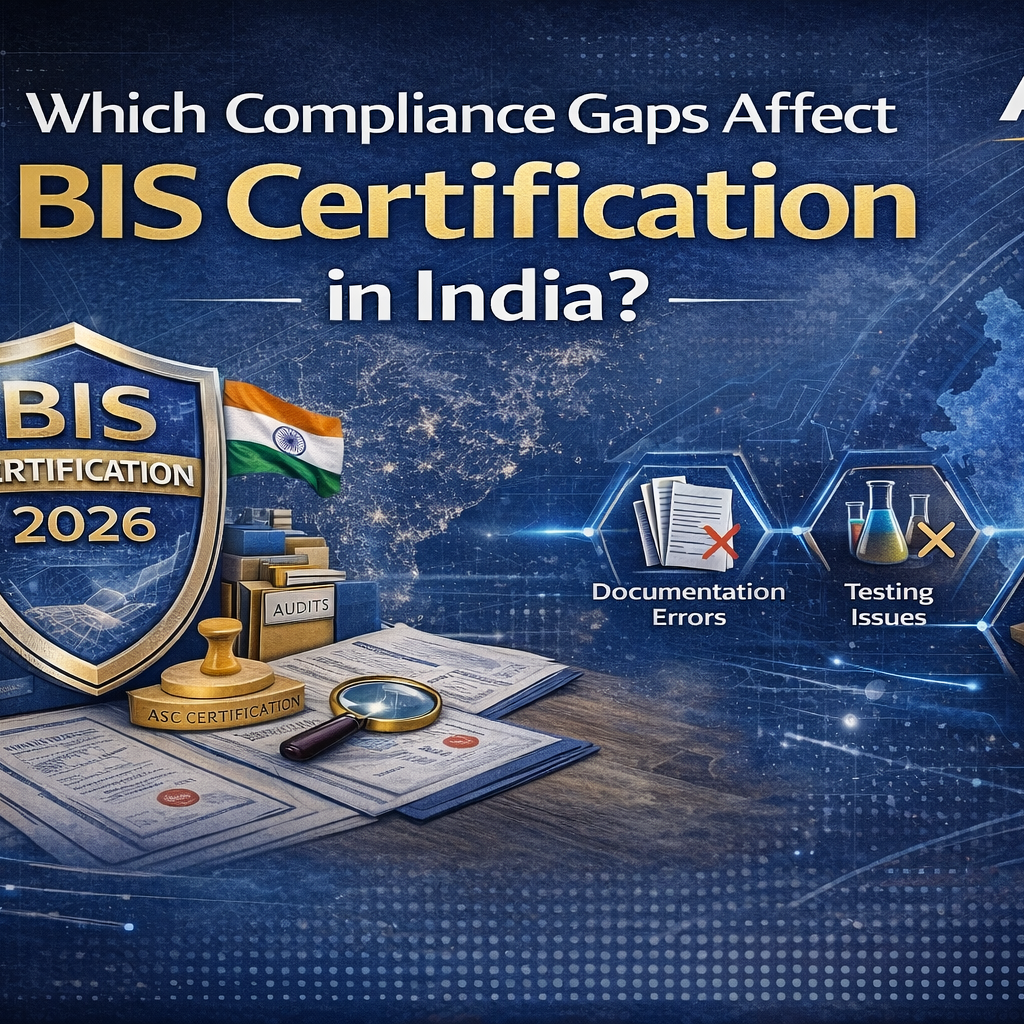

In 2026, bis certification in india, bis certification india has become a mandatory regulatory requirement for manufacturers and importers across multiple industries. Whether applying for BIS Registration, securing a BIS license, or obtaining a BIS Certificate for Import, even minor compliance gaps can significantly delay approval.

While many businesses assume that BIS Certification is simply about submitting documents and test reports, the reality is far more technical. Industry observations show that nearly 30% of BIS applications face queries or delays due to hidden compliance gaps. Identifying and closing these gaps early can save both time and cost.
This blog explains the most common compliance gaps affecting BIS Certification and how ASC Group helps businesses overcome them.
What Happens When Compliance Gaps Are Ignored?
Before identifying the gaps, it is important to understand the consequences:
- Application rejection or repeated clarification notices
- Delay in receiving the bis license certificate
- Shipment detention at customs
- Increased laboratory re-testing costs
- Suspension or cancellation of BIS license
- Damage to brand reputation
A single overlooked compliance issue can impact an entire product launch timeline.
Major Compliance Gaps That Affect BIS Certification
1. Incorrect Product Standard Identification
The Gap
Selecting the wrong Indian Standard (IS code) or applying under an incorrect scheme.
Impact
- Rejection of application
- Requirement to re-apply
- Extended processing time
Solution
Conduct a detailed product classification review before filing for BIS Registration.
2. Incomplete Technical Documentation
The Gap
Missing or inconsistent documentation such as:
- Technical drawings
- Product specifications
- Factory details
- Authorization letters
Impact
- Clarification notices
- Application delay
Solution
Ensure structured documentation preparation and cross-verification.
3. Laboratory Testing Non-Conformity
The Gap
Products failing to meet required parameters during testing.
Common reasons include:
- Design mismatch
- Use of non-compliant components
- Incomplete sample preparation
Impact
- Re-testing costs
- Delay in BIS Certification approval
Solution
Pre-evaluate product specifications before submitting samples to BIS-approved labs.
4. Factory Inspection Preparedness Issues
The Gap
Manufacturing facilities not aligned with quality control expectations.
Authorities may examine:
- Production processes
- Calibration records
- Quality assurance systems
Impact
- Observation reports
- Delayed issuance of BIS license
Solution
Conduct mock audits and internal quality system reviews before inspection.
5. Errors in Online Application Filing
The Gap
Incorrect data entry or mismatched uploads in the BIS portal.
Impact
- Application return or rejection
Solution
Ensure accuracy in portal submissions and document consistency.
6. Import-Specific Compliance Deficiencies
The Gap
For importers applying for a BIS Certificate for Import, issues often arise due to:
- Missing Authorized Indian Representative documentation
- Incorrect labeling
- Incomplete product identification details
Impact
- Customs detention
- Demurrage charges
Solution
Verify importer documentation and product labeling compliance in advance.
7. Post-Certification Monitoring Lapses
The Gap
Failure to maintain quality consistency after receiving the bis license certificate.
Impact
- Suspension or cancellation of BIS license
Solution
Implement periodic internal compliance checks and renewal tracking.
8. Ignoring Regulatory Updates
The Gap
Not monitoring amendments in product standards or mandatory categories.
Impact
- Non-compliance risk
- Market withdrawal
Solution
Stay updated with regulatory notifications and revise documentation accordingly.
Key Question
Why Do Compliance Gaps Occur in BIS Certification India Applications?
Most gaps arise due to lack of technical interpretation, incomplete documentation planning, and insufficient inspection readiness. BIS Certification involves more than paperwork—it requires structured quality alignment and regulatory understanding.
Strategic Framework to Eliminate Compliance Gaps
Businesses can strengthen their BIS approval journey by following:
- Early compliance gap assessment
- Product parameter verification
- Documentation audit before submission
- Factory readiness evaluation
- Continuous monitoring of standards
- Timely renewal and record maintenance
A proactive compliance model reduces avoidable delays.
How ASC Group Helps Close Compliance Gaps
ASC Group provides end-to-end support for businesses seeking BIS Certification. Their services include:
- Detailed product classification and regulatory mapping
- Documentation structuring and verification
- Coordination with BIS-approved laboratories
- Assistance in complete BIS Registration filing
- Inspection readiness planning
- Support for BIS Certificate for Import
- Post-certification monitoring and renewal advisory
By identifying compliance gaps early, ASC Group minimizes rejection risks and accelerates approval timelines.
Why Professional Support Matters
The regulatory framework for bis certification in india, bis certification india is expanding in scope and enforcement intensity. Without structured compliance management, businesses may face operational disruption and financial loss.
Professional guidance ensures:
- Accurate BIS Registration
- Faster BIS license issuance
- Reduced clarification notices
- Long-term regulatory stability
Conclusion
Compliance gaps are the most common reason for delays in BIS Certification approval. From incorrect documentation to inspection unpreparedness, overlooked details can significantly impact market entry timelines.
By proactively addressing these gaps and partnering with ASC Group, businesses can streamline their BIS approval journey, secure timely certification, and maintain sustainable compliance in the Indian market. Structured preparation transforms regulatory challenges into strategic growth opportunities.