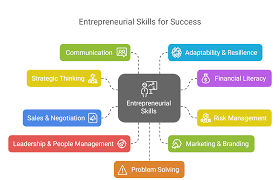

Entrepreneurial skills are the combination of business knowledge, soft skills, and practical abilities that help individuals start, grow, and sustain a successful business. The most important entrepreneurial skills include strategic thinking, financial literacy, communication, leadership, adaptability, and problem-solving. These skills are not fixed traits — most can be developed through experience, deliberate practice, and structured learning, regardless of your background or industry.
Most people who fail at entrepreneurship do not fail because their idea was bad. They fail because they could not execute. They had the vision but not the skills to turn it into something real.
The good news is this: entrepreneurial skills are learned, not inherited. Every skill on this list was developed — by someone who started with none of them — through repetition, feedback, and failure. The question is not whether you can learn them. The question is which ones you need to work on first.
Here are the 10 entrepreneurial skills that consistently separate businesses that grow from ones that stall.
1. Strategic Thinking — See the Business, Not Just the Task
Strategic thinking is the ability to look past today’s problems and make decisions that serve where the business is going, not just where it is. It is the most foundational of all entrepreneurial skills because everything else — hiring, marketing, product development, pricing — flows from it.
Entrepreneurs with strong strategic thinking ask different questions. Not “what should I do today?” but “what decision today will still matter in 12 months?” They identify which opportunities to pursue and — just as importantly — which to ignore.
How to develop it:
- Spend 30 minutes every week reviewing your business from a 12-month view, not a 7-day view
- Study one competitor each month — not to copy them, but to understand their choices
- Read business case studies from industries outside your own — pattern recognition transfers across sectors
A consistent pattern in successful startups is that founders who think strategically from day one build businesses with clearer positioning, fewer pivots, and faster paths to profitability than those who operate entirely in reactive mode.
2. Financial Literacy — Know Where the Money Is Going
You do not need to be an accountant. You do need to understand cash flow, profit margins, burn rate, and basic financial forecasting. Financial literacy is one of the most critical entrepreneurial skills because most early-stage businesses that fail do not run out of ideas — they run out of cash without seeing it coming.
According to research published in multiple small business studies, cash flow problems are cited as a leading factor in business failure for companies in their first three years. The pattern repeats because founders focus on revenue without tracking expenses, or celebrate a large invoice without accounting for the 60-day payment window.
The three numbers every entrepreneur must know at all times:
- Monthly burn rate — how much you spend per month to keep the business running
- Runway — how many months you can operate before cash runs out at the current burn rate
- Break-even point — the revenue level at which income covers all costs
These are not advanced accounting concepts. They are survival numbers. Know them.
3. Communication — The Skill That Sells Everything
Every interaction an entrepreneur has is a communication event. Pitching investors. Writing a product page. Leading a team meeting. Responding to a customer complaint. Negotiating with a supplier. The quality of all of these interactions is determined by how clearly and persuasively you communicate.
Marion Siboni, CEO and founder of La Creme de la STEM, put it directly in a business.com interview: authenticity in communication is the key factor in building strong, lasting relationships with partners, customers, and investors. People buy from people — and they connect through story, not specification.
Communication skills every entrepreneur needs:
- Written communication — emails, proposals, website copy, social media
- Verbal communication — pitching, team briefings, sales conversations
- Active listening — understanding what customers and partners actually need
- Digital communication — tone and clarity across async channels like Slack and email
Writing is particularly underrated as an entrepreneurial skill. The entrepreneurs who write clearly tend to think clearly — and businesses built on clear thinking tend to scale faster.
4. Leadership — Build a Team That Runs Without You
Leadership as an entrepreneurial skill is not about authority — it is about creating the conditions for other people to do their best work. The goal of a good entrepreneurial leader is to eventually build a team that does not need constant direction.
A practical benchmark used by many growth-stage founders: if your business cannot operate normally for one week without you, you have a leadership gap, not a staffing gap. The solution is not more control — it is better systems, clearer roles, and a team that understands the mission well enough to make decisions independently.
Leadership skills to develop:
- Delegation — assign ownership of outcomes, not just tasks
- Feedback — deliver it consistently, specifically, and without ego
- Hiring — learn to identify people who are stronger than you in specific areas
- Conflict resolution — address problems directly before they become culture problems
5. Adaptability — The Skill That Keeps You Alive
Markets shift. Technologies change. Consumer behavior evolves faster than any business plan can predict. Adaptability — the ability to learn, unlearn, and relearn quickly — is what separates entrepreneurs who survive disruption from those who are replaced by it.
Elon Musk’s early pivot of Tesla from a pure EV manufacturer to an energy company with software at its core is a large-scale example of entrepreneurial adaptability. On a smaller scale, the same pattern applies to every business that survived the shift to mobile, the rise of social commerce, and the adoption of AI tools in 2024 and 2025.
Adaptability is not the same as being reactive. It means staying close enough to market signals to recognize when a genuine shift is happening — and moving before you are forced to.
6. Problem-Solving — Find the Real Problem First
Every business exists to solve a problem. The entrepreneurial skill of problem-solving is therefore not optional — it is the entire job. But the higher-level version of this skill is identifying the right problem before trying to solve it.
Most business problems have surface symptoms and root causes. A product that is not selling might appear to be a marketing problem. It might actually be a pricing problem, a positioning problem, or a product-market fit problem. Solving the wrong level of the problem is how entrepreneurs waste months of work.
A practical problem-solving framework:
- State the symptom (what you observe)
- Ask why three times (to find the root cause)
- Generate three possible solutions before committing to one
- Test the smallest possible version of the solution first
This four-step approach is borrowed from lean startup methodology and used by founders at companies ranging from early-stage bootstrapped businesses to Series B startups.
7. Digital Literacy — Understand the Tools That Run Modern Business
Digital literacy is now a foundational entrepreneurial skill — not a technical bonus. In 2026, entrepreneurs who cannot operate confidently across digital tools are at a structural disadvantage in operations, marketing, and decision-making.
According to Statista, 82% of startups integrate automation into daily operations. AI tools, analytics platforms, no-code builders, and automation workflows have shifted from competitive advantages to baseline expectations. Entrepreneurs do not need to code — but they must understand what these tools can do and which ones fit their business.
Core digital literacy areas for entrepreneurs:
- AI tools — content generation, customer support, data analysis
- Analytics — understanding traffic data, conversion metrics, customer behavior
- Automation — email sequences, social scheduling, CRM workflows
- No-code platforms — building landing pages, forms, and simple apps without developers
8. Networking and Relationship Building — Your Network Is Infrastructure
Networking is an entrepreneurial skill that most people undervalue until they need a co-founder, an introduction to an investor, a key hire, or a referral at a critical moment. By then, it is often too late to build the relationship from scratch.
The most effective entrepreneurial networkers do not treat relationships as transactional. They invest in connections consistently — before they need anything — by offering value, making introductions for others, and showing up in the same rooms as the people they want to know.
Industry data shows that founder referrals and warm introductions account for a significant portion of early-stage fundraising, first hires, and first enterprise clients. The businesses with the strongest networks close these opportunities faster and at lower cost than those relying entirely on cold outreach.
9. Resilience and Emotional Intelligence — The Foundation Under Everything
Entrepreneurship is not linear. There will be months where nothing works. Launches that fail. Hires that do not work out. Funding rounds that fall through. Resilience is the entrepreneurial skill that keeps you functioning through these periods rather than collapsing under them.
Emotional intelligence — the ability to manage your own emotions and read the emotions of others accurately — sits underneath resilience and most other leadership skills. Entrepreneurs with high emotional intelligence make better decisions under pressure, build stronger teams, and recover faster from setbacks.
Three practices that build resilience:
- Separate the event from the meaning — a failed product launch is data, not identity
- Build recovery rituals — exercise, sleep, and deliberate disconnection are performance infrastructure
- Maintain a support network outside the business — advisors, peers, mentors
10. Sales — The Skill No Entrepreneur Can Delegate at the Start
Every founder is a salesperson in the early stage of a business — whether they identify as one or not. You sell to your first customers, to your first hire, to your first investor, and to every partner who considers working with you. The ability to sell is therefore not a departmental skill — it is a survival skill.
Entrepreneurs who master sales early don’t just survive — they scale. The sooner you understand what motivates the people you are trying to persuade and how to communicate your value clearly in their terms, the faster everything else in the business accelerates.
Sales skills every entrepreneur must develop:
- Discovery — asking the right questions to understand what a customer actually needs
- Objection handling — addressing concerns without becoming defensive
- Follow-up — most sales happen on the fifth to seventh contact, not the first
- Storytelling — framing value in terms of the buyer’s outcome, not your product’s features
What the Research Shows About Entrepreneurial Skill Development
A consistent pattern across published entrepreneurship research and founder surveys is that the skills most commonly cited as “innate” are actually the ones most reliably developed through structured learning. Resilience, strategic thinking, and communication all appear frequently in lists of traits that successful founders are “born with” — and all three appear just as frequently in studies examining what mentorship, deliberate practice, and real-world failure actually produce.
Research published in the Education Sciences journal identified communication as one of the top differentiating skills between entrepreneurs who scaled successfully and those who plateaued — not because successful founders were naturally better communicators, but because they invested more deliberately in improving.
Most practitioners in the entrepreneurial education space report that the gap between founders who grow and those who stall is rarely the business idea. It is execution capability — specifically the combination of financial literacy, adaptability, and the willingness to sell — that determines which ventures move forward.
Frequently Asked Questions
Q: What are entrepreneurial skills?
A: Entrepreneurial skills are a combination of business knowledge, soft skills, and practical abilities that help individuals start, grow, and sustain a business. They include both technical competencies like financial literacy and digital literacy, and interpersonal abilities like communication, leadership, and resilience. Most entrepreneurial skills are learned through experience, study, and deliberate practice rather than being innate traits.
Q: Which entrepreneurial skill is most important?
A: Strategic thinking is widely cited as the most foundational entrepreneurial skill because it influences every other business decision — from hiring to pricing to product development. However, financial literacy and communication are equally critical in practice. Most business failures trace back to a weakness in one of these three areas rather than a lack of ideas or ambition.
Q: Can entrepreneurial skills be learned?
A: Yes. Research consistently shows that most entrepreneurial skills — including resilience, strategic thinking, communication, and financial literacy — are developed through experience, education, and structured practice. While some individuals have natural tendencies toward risk tolerance or creativity, the practical skills required to build a successful business are accessible to anyone who invests in developing them.
Q: What entrepreneurial skills do beginners need first?
A: Beginners should prioritize three skills first: basic financial literacy (understanding cash flow and burn rate), communication (writing and speaking clearly about your business), and sales (the ability to articulate your value and close a customer). These three create the foundation everything else is built on. Strategic thinking and leadership become more critical as the business grows and complexity increases.
Q: How long does it take to develop entrepreneurial skills?
A: There is no fixed timeline — skill development depends on the skill, the learning method, and the frequency of practice. Communication and writing improve visibly within three to six months of daily practice. Financial literacy builds through hands-on experience managing real budgets. Strategic thinking develops over years of decision-making and reflection. The fastest path for any skill is combining structured learning with immediate real-world application.
The Bottom Line on Entrepreneurial Skills
Building a business is a skill problem before it is a funding problem, a market problem, or an idea problem. The entrepreneurs who succeed consistently are not the ones with the best concepts — they are the ones who developed the right capabilities before they needed them.
Three things to take from this:
- Entrepreneurial skills are learned, not inherited. Every skill on this list has been developed by people who started with none of them.
- Start with financial literacy, communication, and sales. These three skills have the highest leverage in the early stage of any business.
- Adaptability is the meta-skill. The ability to learn quickly — and change direction based on what you learn — underpins every other skill on this list.
If you want to build on what you have read here, start with one skill. Not all ten. Pick the one that would have the biggest impact on your business right now and spend 30 days going deep on it. That is how skills actually develop — one focused investment at a time.