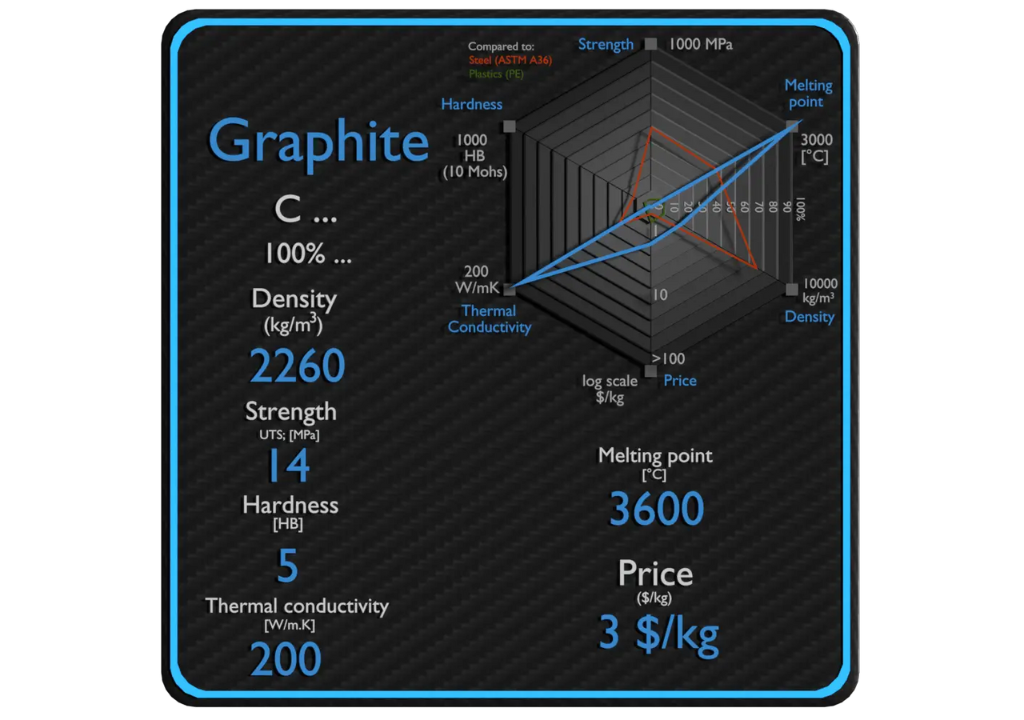

earn about graphite density, including standard values, influencing factors, measurement methods, and why it matters in industrial and engineering applications
Graphite Density Guide: Formula, Typical Range, and Applications
Graphite is a versatile carbon-based material widely used across industries such as metallurgy, electronics, energy storage, aerospace, and chemical processing. Among its many physical characteristics, graphite density plays a crucial role in determining performance, durability, and suitability for specific applications. Engineers and material specialists rely on density values to assess strength, conductivity, and thermal behavior.
This guide explains the graphite density formula, its typical density range, the factors influencing it, and how density affects real-world applications. The content is structured to provide technical clarity while remaining accessible and SEO-friendly.
What Is Graphite Density?
Graphite density refers to the mass of graphite per unit volume, usually expressed in grams per cubic centimeter (g/cm³). It indicates how compact the graphite structure is and how much internal porosity exists within the material.
Because graphite can be produced using different manufacturing methods and raw materials, its density varies significantly. Both natural graphite density and synthetic graphite density differ based on structure, purity, and processing techniques.
Understanding graphite density helps industries choose the correct grade for applications requiring high strength, thermal stability, or electrical conductivity.
Graphite Density Formula Explained
The standard formula used to calculate graphite density is:
Density = Mass ÷ Volume
Where:
- Mass is measured in grams (g)
- Volume is measured in cubic centimeters (cm³)
For example, if a graphite block weighs 180 grams and has a volume of 100 cm³, the density would be:
Density = 180 ÷ 100 = 1.8 g/cm³
This simple formula is commonly used in quality testing, material inspection, and laboratory analysis to verify graphite grade consistency.
Typical Graphite Density Range
The density of graphite depends on its type and manufacturing process. Below is the commonly observed graphite density range:
- Natural graphite: 2.1 to 2.3 g/cm³
- Synthetic graphite: 1.5 to 1.9 g/cm³
- Isostatic graphite: 1.7 to 1.85 g/cm³
- Extruded graphite: 1.6 to 1.75 g/cm³
Higher density usually indicates lower porosity, which improves mechanical strength and conductivity. However, lower-density graphite may be preferred in applications where lubrication or thermal insulation is required.
Factors That Influence Graphite Density
1. Manufacturing Method
Processes such as isostatic pressing, extrusion, and vibration molding directly affect internal structure and density uniformity. Isostatic graphite is known for consistent density throughout the material.
2. Raw Material Quality
The purity and particle size of petroleum coke or natural graphite flakes influence how tightly particles pack during processing, impacting final density.
3. Porosity Level
Porosity reduces overall density. Applications requiring chemical resistance or mechanical strength typically demand graphite with controlled low porosity.
4. Graphitization Temperature
Higher graphitization temperatures improve crystal alignment, slightly increasing density and enhancing electrical and thermal conductivity.
Relationship Between Graphite Density and Material Properties
Mechanical Strength
Higher-density graphite offers improved compressive strength and wear resistance, making it suitable for structural and load-bearing applications.
Thermal Conductivity
Dense graphite allows efficient heat transfer, which is essential in furnace components, heat exchangers, and thermal management systems.
Electrical Conductivity
As density increases, electrical conductivity generally improves due to reduced voids within the structure.
Chemical Resistance
Low-porosity, high-density graphite resists chemical penetration, making it ideal for corrosive industrial environments.
Graphite Density Compared to Other Materials
| Material | Density (g/cm³) |
|---|---|
| Graphite | 1.5–2.3 |
| Steel | ~7.8 |
| Aluminum | ~2.7 |
| Carbon fiber | 1.6–2.0 |
| Activated carbon | 0.4–0.6 |
Graphite offers a unique balance of moderate density, high conductivity, and excellent thermal stability, making it valuable across multiple industries.
Applications Based on Graphite Density
1. Batteries and Energy Storage
High-density graphite is widely used in lithium-ion battery anodes due to its electrical conductivity and structural stability.
2. Electrodes and EDM
Graphite electrodes with controlled density are essential in electric arc furnaces and electrical discharge machining, ensuring precision and durability.
3. Refractory and High-Temperature Uses
Dense graphite is used in crucibles, furnace linings, and heating elements, where resistance to extreme temperatures is critical.
4. Mechanical Components
Graphite with optimized density is used for bearings, seals, and bushings, offering low friction and long service life.
5. Aerospace and Nuclear Applications
High-purity, high-density graphite is used in aerospace structures and nuclear reactors due to predictable performance and thermal stability.
How to Select the Right Graphite Density
Choosing the right graphite density depends on:
- Operating temperature
- Mechanical load
- Electrical or thermal performance needs
- Chemical exposure
- Machining requirements
Reviewing technical datasheets and working with experienced suppliers helps ensure the graphite grade matches application demands.
FAQs About Graphite Density
What is the average density of graphite?
Most graphite grades fall between 1.5 and 2.3 g/cm³, depending on type and processing.
Is higher graphite density always better?
No. Higher density improves strength and conductivity, but some applications require controlled porosity and lower density.
How does graphite density affect conductivity?
Higher density usually leads to better electrical and thermal conductivity due to reduced internal voids.
What is the density of synthetic graphite?
Synthetic graphite typically has a density between 1.5 and 1.9 g/cm³.
Can graphite density be customized?
Yes. Manufacturers adjust density through raw materials, forming methods, and processing conditions.
Conclusion
Graphite density is a critical parameter that influences strength, conductivity, thermal performance, and durability. By understanding the graphite density formula, typical density ranges, and application-specific requirements, industries can make informed material choices that enhance efficiency and reliability.
From batteries and electrodes to high-temperature furnaces and aerospace components, selecting the correct graphite density ensures optimal performance and long-term value. As industrial applications continue to evolve, density-controlled graphite remains an essential material for advanced engineering solutions.