
The educational landscape in Russia is undergoing a seismic shift. Traditional classroom boundaries are dissolving as digital platforms take center stage, driven by a unique combination of high-speed connectivity, government-led digitalization, and a surging demand for IT skills. The Russia E-Learning Market is no longer just a supplementary tool; it has become the backbone of modern academic and professional development.
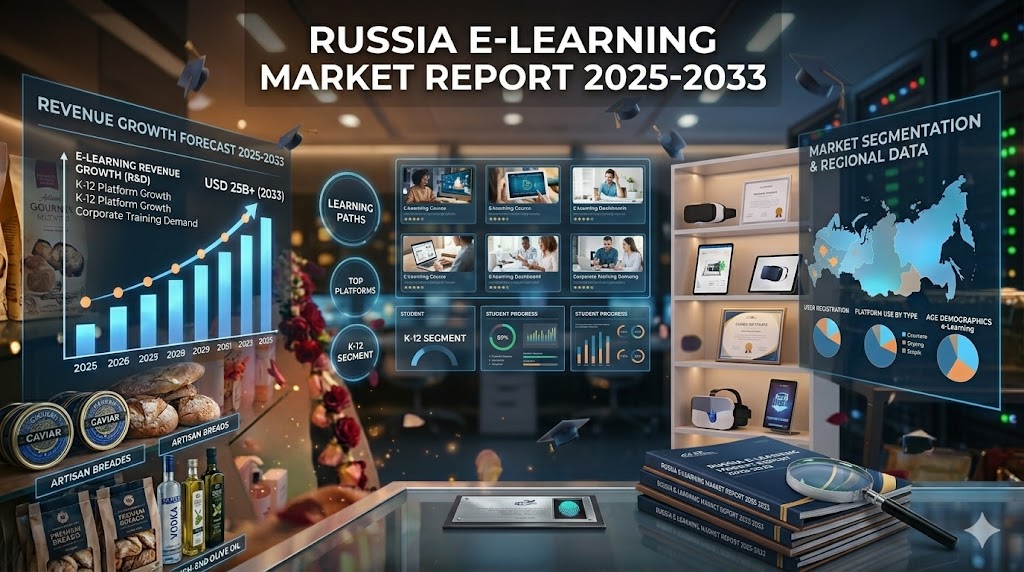
According to the latest market analysis by IMARC Group, the market was valued at USD 1.66 Billion in 2024. However, the growth trajectory is set for an extraordinary leap. Projections indicate the market will reach a staggering USD 11.15 Billion by 2033, exhibiting a powerful Compound Annual Growth Rate (CAGR) of 23.13% during the 2025-2033 period.
Key Drivers: What is Powering the Digital Education Surge?
The rapid expansion of the Russia e-learning market is fueled by foundational shifts in infrastructure and policy.
1. Worldwide Connectivity and Mobile Adoption
A digital revolution requires a connected population. As of early 2024, Russia boasted approximately 219.8 million mobile cellular connections. This widespread access to smartphones and tablets, combined with the expansion of high-speed internet into remote and underserved regions, has democratized education. Flexible, on-demand, and mobile-based learning is now accessible to millions, regardless of their geographic location.
2. Robust Government Initiatives
The Russian government has taken a proactive stance in digitizing education. In September 2024, a single state platform was launched to facilitate online education specifically for IT and school students. This platform focuses on high-demand skills such as Artificial Intelligence (AI), programming, and data analysis. Furthermore, the national project titled “Data Economy” involves an expenditure of approximately USD 7.6 Billion, targeting digital infrastructure and AI development through 2030.
3. Corporate Upskilling and Digital Transformation
Russian corporations are increasingly prioritizing e-learning to bridge the skills gap created by rapid digital transformation. With nearly 60% of the Russian population now obtaining services digitally, businesses are investing heavily in workforce training. Courses in cybersecurity, data science, and business management have seen a significant uptick as companies aim to stay competitive in a data-driven economy.
Sample Request For Your Business
Strategic Market Trends: Hybrid Models and AI
The market is characterized by three major trends that are redefining the student and professional experience.
- Growing Demand for IT Training: As the country adopts strategies for AI development until 2030, specialized IT training has become the market’s primary engine. Collaboration between EdTech firms and universities ensures that certification programs remain industry-relevant.
- Expansion of Hybrid Learning: Educational institutions are blending traditional classroom instruction with digital tools. In February 2024, specialized academic labs were unveiled, featuring VR technology, unmanned vehicle programs, and robotics, allowing students to enhance their technical skills in a safe, simulated environment.
- AI-Driven Personalization: Platforms are increasingly integrating AI to create adaptive learning paths. For instance, the use of ChatGPT-powered chatbots (notably by Skyeng in 2023) assists in language training and interview preparation through real-time, interactive simulations.
Market Segmentation: A Comprehensive Ecosystem
The Russia E-Learning Market is divided into several specialized segments to meet the diverse needs of learners.
By Technology
- Online E-Learning: The core segment, providing interactive video lectures and assessments across IT and finance.
- Learning Management Systems (LMS): Essential for both corporate compliance and university blended learning models.
- Mobile E-Learning: A high-growth area utilizing gamified apps and microlearning for “on-the-go” users.
- Virtual Classrooms: Enabling real-time interaction, particularly vital for remote and higher education.
By Application
- Academic (K-12 & Higher Education): Driven by government reforms and the need for exam preparation and distance degrees.
- Corporate (SMEs & Large Enterprises): Focused on professional development and workforce efficiency.
- Government: Utilizing digital platforms for public sector training and national literacy projects.
Regional Analysis: From Moscow to Siberia
Digital education adoption varies across Russia’s vast territory:
- Central District (Moscow): The primary hub for EdTech startups and corporate training due to high population density and advanced infrastructure.
- Northwestern District (St. Petersburg): A major academic center with a high concentration of research institutes and digitally engaged students.
- Volga and Urals Districts: Industrial centers leveraging e-learning for engineering and manufacturing vocational training.
- Siberian District: A rapidly expanding market where remote education is essential for overcoming geographic barriers.
Competitive Landscape
The market is a battleground of innovation between domestic giants and evolving international players. Local firms like Skyeng, Netology, and GeekBrains dominate the landscape. For context, the educational platform GeekBrains generates an annual revenue of approximately USD 70.7 Million, offering over 50 specialized online courses.
Recent Developments:
- October 2024: Odnoklassniki launched a cultural educational campaign (#OperaCloser) featuring exclusive broadcasts from 20 theaters.
- July 2024: RUDN University launched a virtual 6-month diploma in media and communications to reach global practitioners.
- July 2023: Skyeng introduced AI-driven simulations for spoken business English and interview readiness.
Conclusion
The Russia E-Learning Market is entering a golden age of hyper-growth. With a projected valuation of over USD 11 Billion by 2033, the transition from physical to digital is absolute. Driven by massive government investment in the “Data Economy” and a cultural shift toward lifelong learning, the industry is set to provide unprecedented opportunities for students, professionals, and technology providers. As AI and VR become standard components of the curriculum, the future of Russian education looks more accessible, interactive, and efficient than ever before.