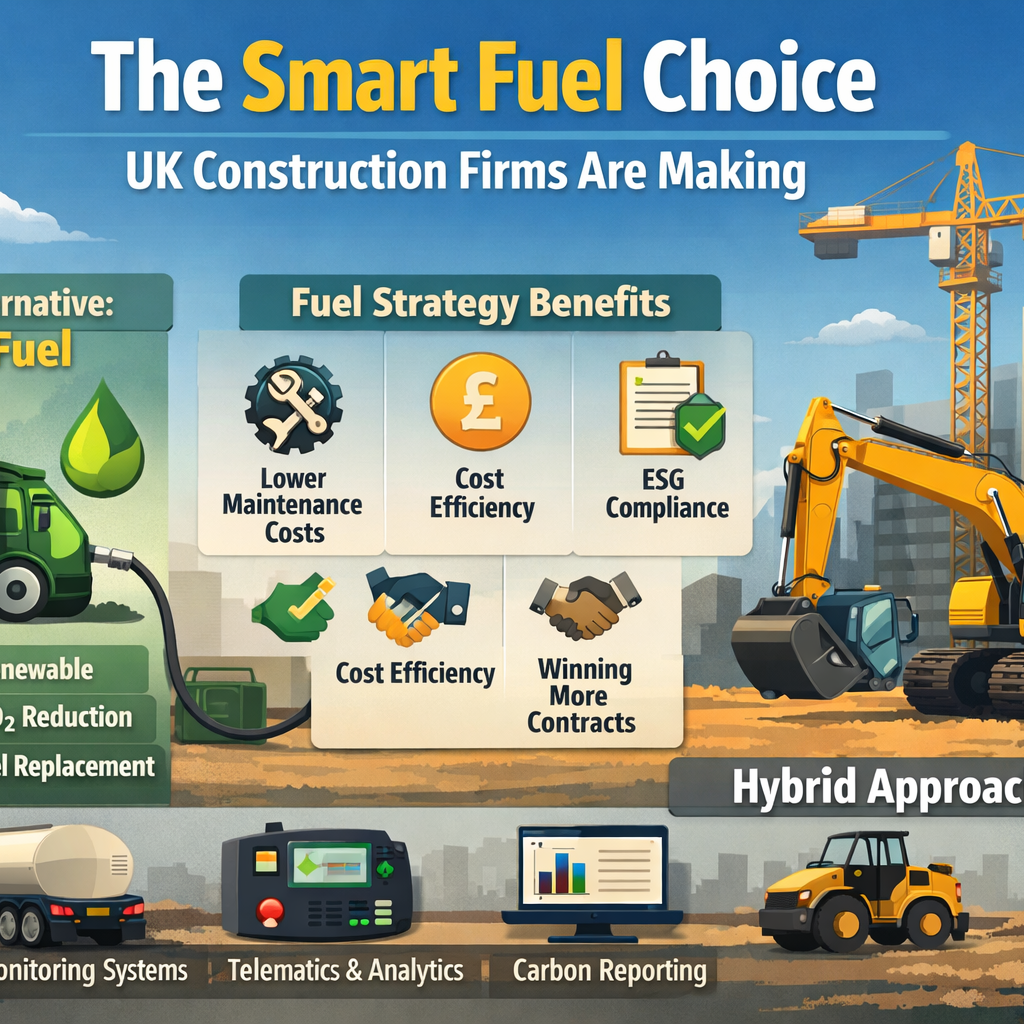

The UK construction industry has never been under more pressure. Rising fuel prices, tighter emissions regulations, expanding urban clean air zones, and the drive toward net zero are forcing contractors to rethink long-standing operational habits. For decades, red diesel was the backbone of construction fuel strategy. Today, that era is changing — and smart UK construction firms are adapting fast.
The question is no longer if businesses should rethink their fuel choices. It’s how they can do it without increasing operational costs or compromising performance.
After two decades in content strategy within the industrial and construction sector, one pattern is clear: the most successful construction companies are not simply reacting to policy changes — they are strategically choosing smarter fuel alternatives that align with compliance, cost control, and sustainability.
Let’s explore what that smart fuel choice looks like in today’s UK construction landscape.
Why Fuel Strategy Has Become a Board-Level Decision
Fuel used to be a site manager’s responsibility. Now, it’s a boardroom discussion.
Three major shifts have driven this change:
- Red diesel tax reform (April 2022) – Most construction firms lost entitlement to use rebated fuel.
- Environmental regulation expansion – Clean Air Zones (CAZ) and Ultra Low Emission Zones (ULEZ) continue to grow.
- Corporate ESG commitments – Developers and investors increasingly demand greener supply chains.
Fuel is no longer just about keeping machines running. It directly impacts profitability, reputation, and contract eligibility.
The Shift Away from Red Diesel
For decades, red diesel was the default choice for off-road construction machinery due to its lower duty rate. However, with entitlement largely removed for construction, companies have had to reassess their options.
The immediate switch to white diesel increased operational costs. But forward-thinking firms didn’t stop there. Instead of simply absorbing higher fuel bills, they began exploring smarter alternatives.
And that’s where the industry pivot began.
The Rise of HVO: The Smart Alternative
One of the most significant changes across UK construction sites is the growing adoption of Hydrotreated Vegetable Oil (HVO).
Why HVO Is Gaining Ground
HVO is a renewable diesel alternative made from waste oils and fats. It is a drop-in replacement for standard diesel, meaning:
- No engine modifications required
- No infrastructure overhaul needed
- Immediate emissions reductions
For contractors juggling multiple sites and fleets, this simplicity is critical.
Environmental Advantages
HVO can reduce greenhouse gas emissions by up to 90% compared to fossil diesel (depending on feedstock and supply chain). For firms bidding on public sector contracts or working with sustainability-focused developers, this reduction provides a measurable competitive edge.
Operational Performance
Unlike traditional biodiesel (FAME), HVO:
- Has superior cold-weather performance
- Produces fewer particulates
- Burns cleaner, reducing engine deposits
This means fewer maintenance interruptions and improved machine longevity.
Cost vs. Value: The Bigger Picture
At first glance, HVO can be more expensive per litre than standard white diesel. But leading firms look beyond pump price.
Here’s what they factor in:
- Reduced maintenance costs
- Extended equipment lifespan
- Lower risk of downtime
- Improved ESG scoring
- Stronger bid positioning
- Futureproofing against regulatory tightening
When viewed strategically, the cost difference becomes an investment in long-term resilience.
Electrification: Is It the Answer?
Electric machinery is often discussed as the future of construction fuel. And in some scenarios — particularly urban and indoor projects — it absolutely is.
However, widespread electrification faces real challenges:
- Limited grid capacity on remote sites
- High upfront capital costs
- Charging infrastructure constraints
- Battery performance in heavy-duty operations
Most UK construction firms are therefore adopting a hybrid strategy:
- HVO for heavy plant and generators
- Electric tools and smaller machinery where practical
- Telematics to optimise fuel consumption
It’s not about choosing one solution. It’s about choosing the right mix.
Smarter Fuel Management Through Technology
The most progressive construction firms are combining alternative fuels with smarter fuel monitoring systems.
Modern fuel strategy now includes:
- On-site fuel management systems
- Telematics integration
- Consumption analytics
- Carbon reporting dashboards
This allows directors to see exactly how much fuel is used, where waste occurs, and how emissions compare across projects.
Fuel is no longer invisible overhead. It’s measurable performance data.
Winning More Contracts Through Smarter Fuel Choices
Sustainability is no longer marketing fluff — it’s a procurement requirement.
Public sector frameworks, major infrastructure projects, and large commercial developments increasingly score environmental performance as part of the tender evaluation process.
Construction firms using renewable fuels like HVO can:
- Provide verified carbon reduction data
- Strengthen ESG credentials
- Demonstrate proactive compliance
- Align with client net zero targets
In competitive tendering environments across the UK, this can be the difference between winning and losing a project.
The Reputation Factor
Beyond regulation and cost, there’s reputation.
Communities are more aware of air quality. Local authorities are stricter. Developers are under pressure from investors.
A construction firm that actively reduces emissions positions itself as:
- Forward-thinking
- Responsible
- Compliant
- Environmentally aware
That perception matters — especially in long-term framework agreements.
Challenges to Consider
No fuel transition is without complexity.
UK firms must carefully assess:
- Supplier credibility and fuel certification
- Supply chain reliability
- Storage compatibility
- Cold weather performance
- Carbon accounting transparency
Due diligence is essential. Not all renewable fuels are equal. Sustainability claims must be backed by verifiable data.
What the Smartest UK Construction Firms Are Doing Now
From my industry observation, the leaders are:
- Trialling HVO across select projects before full rollout
- Tracking emissions reductions project by project
- Training site managers on fuel efficiency
- Investing in telematics and fuel analytics
- Integrating sustainability into procurement strategy
They are not waiting for the next regulation to force change. They are acting ahead of it.
And that’s why they’re leading the market.
The Future of Construction Fuel in the UK
The direction is clear:
- Reduced fossil diesel reliance
- Increased renewable fuel adoption
- Gradual electrification where viable
- Smarter fuel monitoring
- Stricter emissions reporting
Fuel strategy is no longer operational detail — it’s strategic advantage.
The firms that understand this are not just surviving regulatory reform. They’re turning it into competitive leverage.
Frequently Asked Questions (FAQs) – UK Construction Industry
1. Can UK construction companies still use red diesel?
Since April 2022, most construction businesses are no longer entitled to use rebated red diesel. Only specific sectors retain eligibility. The majority of construction firms must now use fully taxed fuel.
2. Is HVO legal and compliant in the UK?
Yes. HVO is fully compliant for use in diesel engines and meets UK fuel standards when sourced from reputable suppliers. It is widely accepted across construction, infrastructure, and transport sectors.
3. Does switching to HVO require engine modifications?
No. HVO is a drop-in replacement for standard diesel. Most modern diesel engines can use it without modification. However, manufacturers’ guidance should always be checked.
4. Is HVO more expensive than white diesel?
Typically, yes — per litre. However, many firms find that reduced maintenance, improved ESG scoring, and long-term compliance benefits offset the higher initial cost.
5. Will using renewable fuels help win UK public sector contracts?
Increasingly, yes. Many public sector frameworks and major contractors assess carbon reduction strategies as part of tender scoring. Demonstrating renewable fuel use can strengthen your submission.
6. Is electric plant equipment realistic for UK construction sites?
It depends on the project. Urban, indoor, or short-term sites may benefit from electric equipment. Large-scale or remote projects still rely heavily on liquid fuels due to power supply limitations.
7. How can construction firms track fuel efficiency more effectively?
By implementing telematics systems, on-site fuel management tanks, and carbon reporting software. Data-driven fuel management is becoming standard practice among leading UK contractors.
Final Thoughts
The smart fuel choice UK construction firms are making isn’t about following a trend. It’s about adapting strategically to economic, environmental, and regulatory realities.
Red diesel may have shaped the past. Renewable fuels, smarter analytics, and flexible energy strategies are shaping the future.