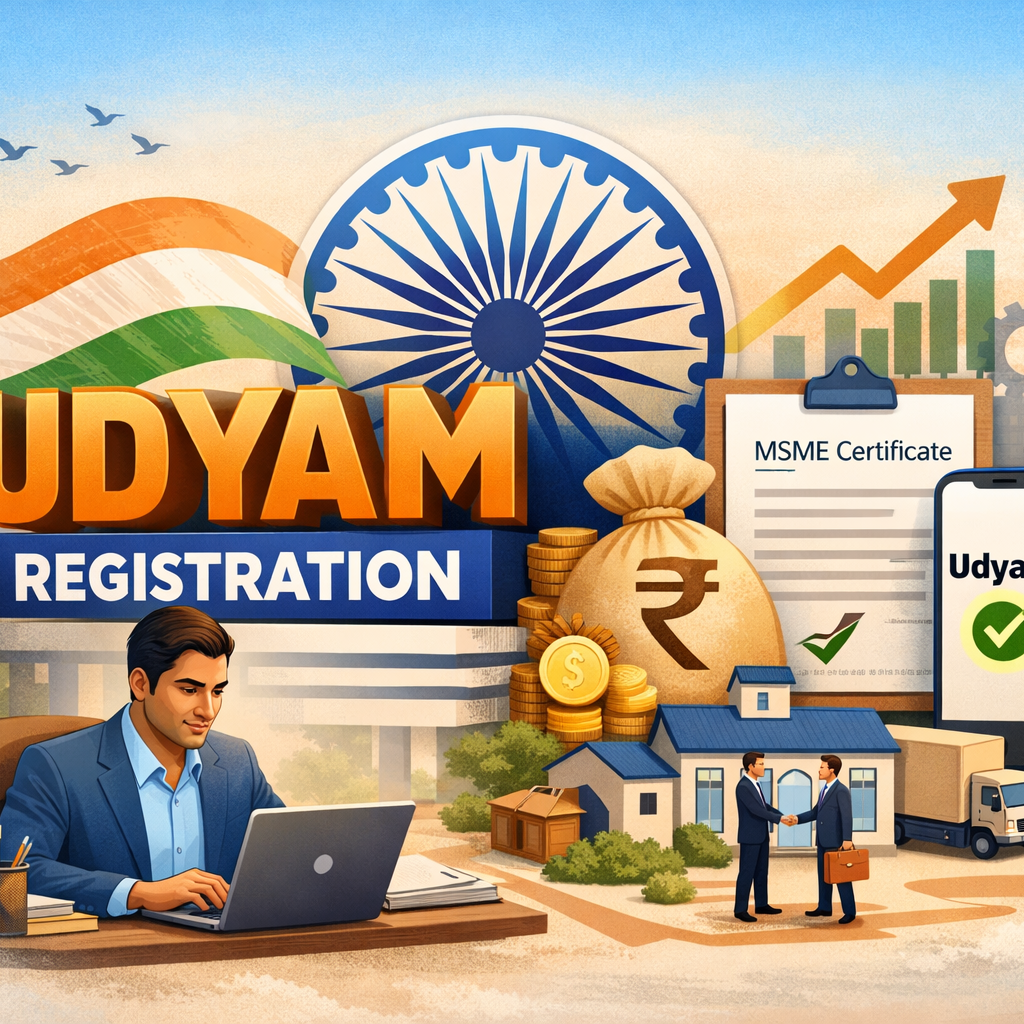

Udyam Registration is a government-backed online process that officially recognizes Micro, Small, and Medium Enterprises (MSMEs) in India. Introduced by the Ministry of Micro, Small and Medium Enterprises, this registration system has replaced the earlier Udyog Aadhaar framework and aims to simplify compliance, improve transparency, and ensure that small businesses receive timely benefits. For entrepreneurs, startups, and growing enterprises, Udyam Registration acts as a gateway to financial assistance, policy support, and business credibility.
In today’s competitive business environment, formal recognition is crucial. Udyam Registration not only validates the existence of an enterprise but also helps it integrate into the formal economy. With a completely paperless and Aadhaar-based process, the government has made it easier than ever for businesses to register and unlock MSME benefits.
What Is Udyam Registration?
Udyam Registration is an online certification system for MSMEs based on self-declaration. Enterprises are classified as Micro, Small, or Medium depending on their investment in plant and machinery or equipment and their annual turnover. Once registered, the enterprise receives a unique Udyam Registration Number (URN) and an e-certificate that serves as official proof of MSME status.
The registration process does not require the submission of physical documents. Details such as PAN and GST are automatically verified through government databases, ensuring accuracy and reducing manual errors.
Classification of MSMEs Under Udyam
The MSME classification under Udyam Registration is uniform across manufacturing and service sectors. The categories are defined as follows:
- Micro Enterprise: Investment up to ₹1 crore and turnover up to ₹5 crore
- Small Enterprise: Investment up to ₹10 crore and turnover up to ₹50 crore
- Medium Enterprise: Investment up to ₹50 crore and turnover up to ₹250 crore
This revised classification allows businesses to grow without the fear of losing MSME benefits too early.
Who Should Apply for Udyam Registration?
Udyam Registration is suitable for a wide range of businesses, including sole proprietorships, partnership firms, Hindu Undivided Families (HUFs), private limited companies, limited liability partnerships (LLPs), cooperative societies, and trusts engaged in eligible economic activities.
Any business that falls within the MSME investment and turnover limits can apply. Even existing businesses registered under earlier MSME frameworks are required to migrate to the Udyam portal.
Benefits of Udyam Registration
Registering under Udyam offers several financial, operational, and legal advantages:
- Easier access to collateral-free bank loans
- Lower interest rates on business credit
- Eligibility for government subsidies and incentive schemes
- Protection against delayed payments from buyers
- Preference in government tenders and procurement
- Reduced fees for trademark and patent registration
- Improved credibility with customers and vendors
These benefits collectively help MSMEs reduce costs, improve cash flow, and scale operations sustainably.
Documents Required for Udyam Registration
The Udyam Registration process is minimalistic and paperless. The basic details required include:
- Aadhaar number of the proprietor or authorized signatory
- PAN of the enterprise
- GST details, if applicable
- Bank account information
No physical documents need to be uploaded, making the process fast and user-friendly.
Step-by-Step Process to Register on Udyam Portal
The online registration process involves the following steps:
- Visit the official Udyam Registration portal
- Enter Aadhaar details and verify through OTP
- Provide PAN and business information
- Fill in enterprise details such as address, activity type, and bank information
- Submit the application and receive the Udyam Registration Number
Upon successful submission, the Udyam Registration Certificate is generated and sent electronically.
Validity and Update of Udyam Registration
Udyam Registration does not have an expiry date. However, enterprises must update their details if there is a change in turnover, investment, address, or business activity. Timely updates ensure continued eligibility for MSME benefits.
Failure to update accurate information may lead to reclassification or suspension of benefits.
Common Mistakes to Avoid During Registration
While the process is simple, businesses should be cautious about:
- Entering incorrect Aadhaar or PAN details
- Providing inaccurate turnover or investment figures
- Using unofficial websites or agents
- Ignoring updates after business expansion
Avoiding these mistakes helps ensure smooth registration and uninterrupted benefits.
Why Udyam Registration Is Important for Business Growth
Udyam Registration acts as a foundation for long-term growth. It enhances a business’s credibility, improves access to finance, and ensures participation in government-led initiatives. In an era where compliance and transparency matter, being Udyam-registered signals trustworthiness to lenders, partners, and customers.
Moreover, with increasing digital integration in government services, Udyam Registration helps businesses stay aligned with evolving regulatory frameworks.
Conclusion
Udyam Registration is more than just a formal requirement—it is a strategic advantage for MSMEs in India. By registering under Udyam, businesses gain access to financial support, legal protection, and growth opportunities that are essential in a competitive market. Whether you are a startup or an established enterprise, Udyam Registration lays the groundwork for sustainable success and long-term stability.
For MSMEs aiming to expand, innovate, and compete at a higher level, Udyam Registration is a smart and necessary step.