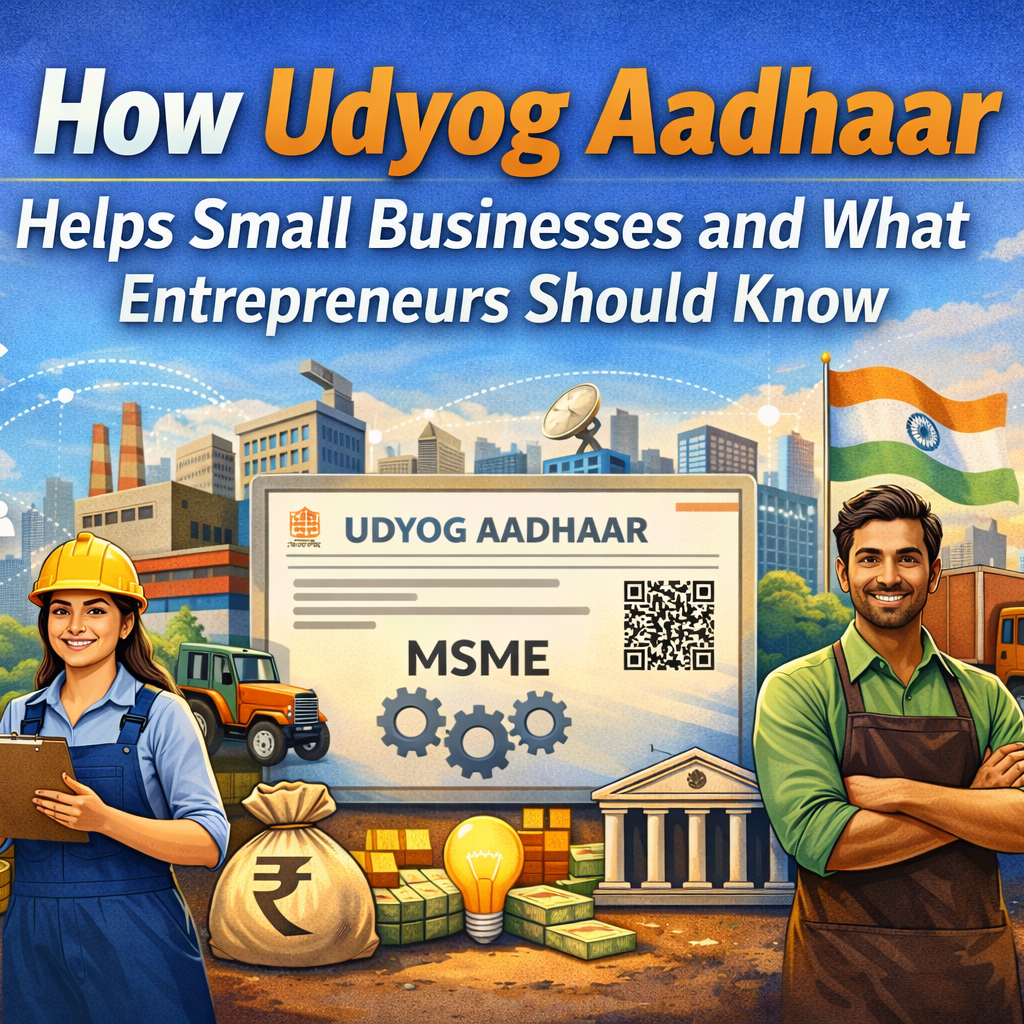

Micro, small, and medium enterprises play a crucial role in India’s economic development. They contribute to employment generation, industrial output, exports, and regional growth. Despite their importance, many MSMEs face difficulties due to lack of formal recognition, limited financial access, and complex regulatory procedures. To address these challenges, the government introduced Udyog Aadhaar, also known as Udyog Aadhar, as a simplified digital registration system.
Udyog Aadhaar was designed to make MSME registration easy, accessible, and cost-free, helping businesses integrate into the formal economy and access essential support.
What Is Udyog Aadhaar?
Udyog Aadhaar is a unique identification number issued to enterprises classified as micro, small, or medium. It serves as official recognition under the MSME framework and enables businesses to avail themselves of various government benefits, financial schemes, and legal protections.
The registration process is entirely online and based on self-declaration, eliminating the need for physical paperwork or lengthy approvals.
Why Udyog Aadhaar Is Important for MSMEs
Udyog Aadhaar plays a vital role in strengthening the MSME ecosystem.
Formal Recognition
Registration helps businesses gain official recognition, improving their credibility in the market.
Ease of Doing Business
By simplifying compliance requirements, Udyog Aadhaar reduces administrative burden.
Access to Government Support
Registered MSMEs can participate in various schemes aimed at growth and development.
Improved Financial Opportunities
Formal registration improves eligibility for institutional financing.
These factors make Udyog Aadhaar an essential tool for small businesses.
Who Can Register Under Udyog Aadhaar?
A wide range of enterprises are eligible to register, including:
- Individual entrepreneurs
- Sole proprietorships
- Partnership firms
- Private limited companies
- Limited liability partnerships
- Hindu Undivided Families
- Co-operative societies
- Manufacturing units
- Service-based businesses
Both new and existing enterprises can apply, provided they meet MSME classification norms.
Key Features of Udyog Aadhaar
Udyog Aadhaar offers several features that simplify MSME registration.
Digital and Paperless Process
The entire registration is completed online.
Self-Declaration-Based System
No documents are required at the time of registration.
Free Registration
There is no cost involved in obtaining Udyog Aadhaar.
Instant Issuance
A unique identification number is generated immediately after submission.
Nationwide Accessibility
Businesses from any part of India can register easily.
These features ensure a hassle-free experience for entrepreneurs.
How the Registration Process Works
The registration process is designed to be simple and efficient.
Step 1: Aadhaar Verification
The applicant verifies Aadhaar details through a secure process.
Step 2: Business Information Submission
Details such as enterprise name, organization type, PAN, address, bank information, nature of activity, employee count, investment, and turnover are entered.
Step 3: Self-Certification
All information is submitted based on self-declaration.
Step 4: Certificate Generation
The Udyog Aadhaar number and digital certificate are issued instantly.
The entire process usually takes only a few minutes.
Benefits of Udyog Aadhaar for Small Businesses
Udyog Aadhaar offers multiple advantages that support MSME growth.
Better Access to Finance
Registered enterprises are eligible for priority sector lending and MSME loan schemes.
Government Incentives and Subsidies
Businesses can benefit from programs related to technology upgrades, infrastructure, and skill development.
Protection Against Delayed Payments
Registered MSMEs receive legal protection for timely payments.
Participation in Government Procurement
Many procurement policies encourage MSME participation.
Enhanced Business Credibility
Formal recognition builds trust with customers, suppliers, and financial institutions.
Support for Expansion and Modernization
Enterprises gain access to training and development initiatives.
These benefits help MSMEs achieve stability and long-term growth.
Role of Udyog Aadhaar in Digital Governance
Udyog Aadhaar aligns with India’s digital governance initiatives by promoting:
- Paperless registration
- Faster service delivery
- Improved transparency
- Centralized MSME data
- Inclusion of rural and small entrepreneurs
The digital framework ensures efficiency and accountability.
Common Misconceptions About Udyog Aadhaar
Some misconceptions discourage businesses from registering.
Registration Is Mandatory
Registration is voluntary but highly beneficial.
Only Manufacturing Units Are Eligible
Service providers and traders can also register.
Loan Approval Is Guaranteed
Registration improves eligibility but does not guarantee approval.
Documents Are Required
The process relies on self-declaration without document uploads.
Understanding these points helps entrepreneurs make informed decisions.
Impact of Udyog Aadhaar on the MSME Sector
The introduction of Udyog Aadhaar has positively impacted MSMEs by:
- Increasing formal business registrations
- Improving access to institutional finance
- Enhancing participation in government schemes
- Strengthening legal protection
- Supporting data-driven policy decisions
These outcomes have improved confidence among small business owners.
Conclusion
Udyog Aadhaar, also known as Udyog Aadhar, has transformed MSME registration in India by offering a simple, digital, and cost-free process. It enables small businesses to gain formal recognition, access financial support, and benefit from government initiatives.
For MSMEs aiming to grow sustainably, improve credibility, and operate efficiently, Udyog Aadhaar remains an important step toward long-term success.